
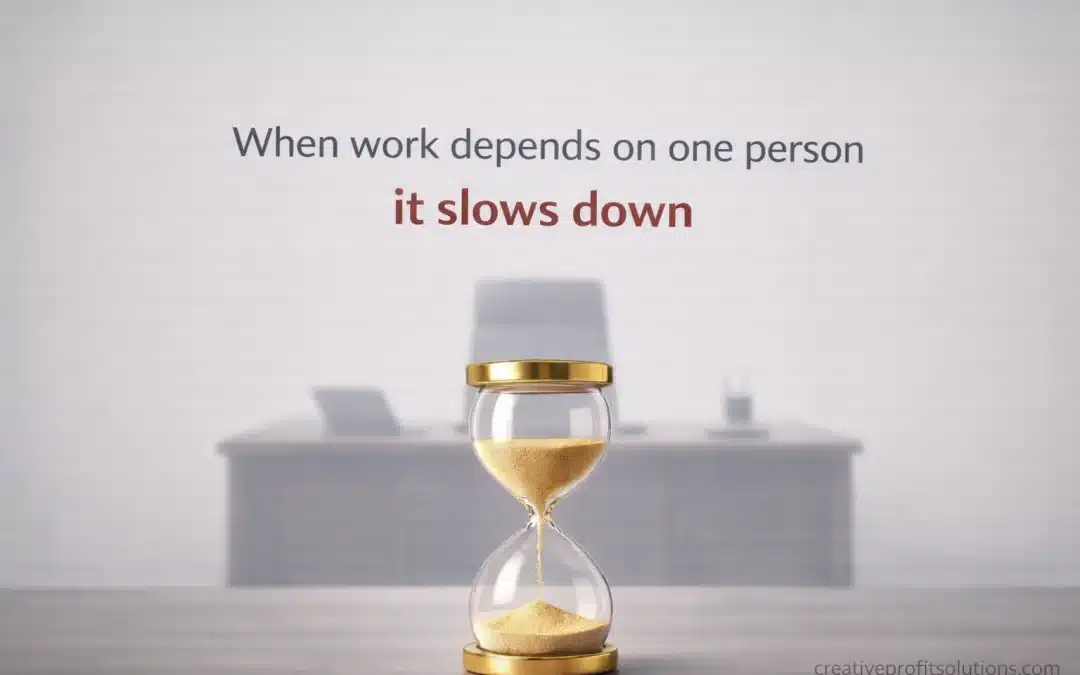
Why Your Business Cannot Run Without You
This article is part of The Profit Gap Series: Why revenue stops turning into cash in founder-led service businesses.
THE PROFIT GAP SERIES
Why Revenue Stops Turning Into Cash
Part 4 — You Are Here — Why Your Business Cannot Run Without You (And How To Change That)
In Part 3 of the Series, we explored why projects keep taking longer than planned and how delivery drift quietly erodes profit.
But timeline drift is usually only a symptom.
A deeper question reveals the real issue.
What would happen if you stepped away from your business for seven days?
No calls.
No approvals.
No stepping in to “fix” things.
Would projects continue moving at the same speed?
Or would progress slow until you returned?
For many founder-led businesses, the answer is uncomfortable.
Work continues.
But momentum weakens.
CPS Insight
If progress slows the moment you step away, the business is not running on systems yet.
It is still running on you.
The Moment the System Breaks
When a business cannot run without you, it usually means one thing.
The execution logic still lives within you.
You know:
• what quality should look like
• how decisions should be made
• what happens when something goes wrong
But the team only sees fragments of that logic.
So when uncertainty appears, work flows back to the founder.
Over time that becomes the default workflow.
Not because the team lacks capability.
But because the system never captured the knowledge required to move forward.
• Who makes the final decision when something unexpected happens?
• Can the team resolve it without asking you?
• Are the rules written down somewhere they can follow?
If the answer is no, execution will keep returning to the founder.
Where My Understanding of Systems Actually Started
My first exposure to process thinking didn’t come from operations consulting.
It came from fashion school.
When learning how to construct garments, the work followed a very specific sequence.
Inserting a zip could have 20 steps.
A short collar could require 35 steps or more.
Constructing a garment from start to finish involved multiple stages, each with its own process.
— Drafting the pattern
— Preparing the fabric
— Cutting the pieces
— Assembly
— Finishing
At some point, I started writing the steps down.
Not because anyone required it.
I simply needed a way to remember the sequence and avoid getting overwhelmed.
Those notes became something I constantly referred back to whenever I needed to recreate the process.
I never thought of them as SOPs.
They were simply instructions that made the work repeatable.
Years later, when I built production operations, that habit became the foundation of how the business ran.
Instead of relying on memory, the workflow was documented:
— Client intake
— Measurements
— Pattern preparation
— Cutting
— Assembly
— Quality checks
— Delivery
From that moment, execution stopped relying on my memory and started following a documented path.
CPS Insight
When the steps are written down, anyone can follow the process.
How the Process Created Structure
At first, the team asked questions constantly.
Clarifications came through quick messages while they were learning how the work flowed.
Eventually, the team began documenting the basic steps required to produce each design based on previous production runs.
Those steps were written down as a process manual before a sample was created.
The sample maker would then create the first piece using those steps.
During sample-making, new details always emerged.
— Small adjustments
— Missing instructions
— Better ways of sequencing the work
After the sample was completed, the process was updated again.
Only then were the final steps posted on the wall before bulk production began.
After a few test runs, we all agreed the laid-out structure worked.
I also streamlined the types of orders we accepted from designers so we could scale.
At some point, I stopped answering operational questions directly.
When someone came to me with a question, I simply referred them back to the process manual.
So the team got used to checking the documented steps before asking for clarification.
Over time, the questions reduced dramatically.
Not because the team stopped asking questions.
But because the answers were already written down.
The steps were documented.
The handoffs were predictable.
The process carried the work forward.
the team stops needing the founder to interpret every situation.
When the System Took Over
After a while, I stopped being the person everyone asked for direction.
The system became the reference point.
With time, the business reached a stage where it ran for two years without requiring my daily involvement.
Clients spoke with the team.
Projects moved forward.
Work was delivered.
That stability didn’t happen because the team became perfect.
It came from turning my tacit knowledge into processes anyone could follow.
Once the system carried the execution, I was able to focus on higher-level decisions and growth instead of constant intervention.
A business becomes an asset only when execution continues without the founder present.
The Real Bottleneck: Decision Flow
In most founder-led businesses, the real constraint is not labor.
It is decision flow.
Work eventually reaches a point where someone must decide:
Is this acceptable?
Should we move forward?
Does this meet the standard?
If the answer only exists with the founder, work slows until the founder responds.
Not because the team lacks ability.
But because the decision rules were never made visible.
Once those rules become clear, decisions move closer to the work.
And execution stops waiting for the founder.
Operational Lesson for Founders
There are three operational lessons founders can take from this process.
1. Processes must be written before execution begins
If steps are only with the founder, the team will always return to the founder for decisions.
2. Processes must evolve after the first execution
The first attempt always reveals missing steps.
Systems improve when the process is updated based on what actually happened.
3. Processes must remain living documents
Stable operations are not created by writing procedures once.
They are created by continuously improving how work moves through the business.
This discipline is common in manufacturing.
But the same logic applies to agencies, consulting firms, and project-based businesses.
Execution becomes stable when the work no longer depends on the founder remembering how everything should be done.
CPS Insight
A business becomes scalable when execution continues even when the founder steps away.
Stop Being the System
If your business cannot run without you, its growth will always be limited by your personal capacity.
Not by demand.
Not by opportunity.
But by how much work you can personally absorb.
That is why founder-dependent businesses feel exhausting even when revenue grows.
The solution is not working harder.
It is designing systems that carry the work without requiring constant intervention.
Turn Your Founder Knowledge Into Systems
If execution slows the moment you step away, the business is still relying on knowledge only you carry.
We help founders convert tacit operational knowledge into clear SOPs and delivery systems the team can run without constant intervention.
Not ready for implementation yet?
Quantify Your Financial Gap with the Margin Leak Audit™
See in real numbers where delivery is absorbing profit.
Or Take the Profit Risk Assesment
to identify the operational risks slowing your business down.
FAQs
Why does my business depend on me for daily decisions?
In many founder-led businesses, the decision rules for quality, scope, and execution were never documented.
When uncertainty appears, work returns to the founder because the team does not have clear guidance for how to proceed.
Why does work slow down when the founder steps away?
When key decisions rely on the founder’s judgment, progress pauses until those decisions are made.
This creates hidden bottlenecks that slow delivery even when the team is capable of completing the work.
Is founder dependency normal in growing businesses?
It is common, especially in businesses built around the founder’s expertise.
However, long-term stability requires translating that expertise into clear processes so the team can execute without constant intervention.
Why do teams keep asking the founder questions?
Most teams ask questions because the decision rules are not visible.
When processes and quality standards are documented clearly, the number of interruptions drops dramatically.
What is the first step to reducing founder dependency?
The first step is identifying where decisions and execution steps rely on the founder rather than documented systems.
Once those gaps are visible, processes can be built to carry the work forward without constant founder involvement.
About the Author
Temi is a Fractional COO and Profit Architect who works with owner-led service and project-based businesses where revenue is consistent but profit never reaches the bank. Her work identifies the structural gaps between what a business bills and what it actually keeps — and builds the operational systems that close them. She founded Creative Profit Solutions after a decade running manufacturing operations and applying Big Four accounting discipline to the delivery economics of founder-led businesses.
Work with Temi → Get in touch
Recent Articles

How Do I Know If a Project Made Money?
A paid invoice proves the client paid but doesn’t prove the project made money. Here is what the usual checks miss, and where a fully paid project quietly bleeds cash.
5 Hidden Margin Leaks Destroying $1M Service Businesses
Many service businesses hit $1M in revenue only to discover cash flow remains tight, delivery pressure keeps increasing, and the founder is still absorbing operational gaps personally. This article breaks down the five hidden margin leaks quietly destroying profitability during execution.

Why Does My Business Feel Harder As It Grows?
The business is growing. So why does it feel harder to run?
More clients. More revenue. More team. And somehow, more of everything still routes back to you.
Growth was supposed to create leverage. Instead it created pressure.
This article breaks down why that happens and what needs to change before scaling makes it worse.
