

Why Do Clients Always Ask For Discounts? And How To Handle It Without Losing Margin
This article is part of the Search Decoded Series: What founders search and what those questions actually mean.
THE SEARCH DECODED SERIES
What Founders Search
Part 4 — You Are Here — Why Do Clients Always Ask For Discounts? And How To Handle It
“Can I get a discount?”
This is where your business's structure gets tested.
The client is happy with the proposal.
And they have decided to move forward.
Nothing about the work or the scope has changed.
But now the price is under pressure.
A discount request is where pricing stops being theoretical
and starts being tested in real conditions.
What a Discount Request Actually Means
A discount request is simple on the surface.
But the real question behind a request for a price reduction is:
“Can I pay less for the same thing?”
What happens next determines where the cost goes.
You get to decide if:
- the work changes, or
- the business absorbs the difference.
the business funds the difference.
Why Clients Ask for Discounts
Clients ask for discounts because they can.
At that point in the conversation, there is very little left for them to influence.
The work is defined.
The direction is agreed.
Price becomes the only lever left.
It is the only thing still within their control.
So that is what they push on.
When everything else is fixed, price becomes the default pressure point.
It is a normal part of how clients evaluate a decision.
They are weighing:
- the value of the outcome
- the benefit to their business
- the opportunity cost of saying yes
And price is where that evaluation shows up.
What You Need Before You Respond
You cannot handle discount requests in the moment.
You need to be grounded in your numbers before the conversation happens.
That means knowing:
- how long the work actually takes,
- what it costs the business to deliver it, and
- how much margin exists in the price.
If you do not know those three things, you are guessing.
And in negotiation, guessing leads to giving.
you do not know what you can afford to give up.
For example, you quote a project at $25,000.
The client asks if you can do it for $20,000.
That is a $5,000 reduction.
Before you respond, you need to understand what that $5,000 removes.
If your margin was $6,000, you are now left with $1,000.
If your margin was $4,000, you are now delivering the project at a loss.
Discounts do not reduce work.
They reduce what the business keeps.
What This Looks Like In Production
This becomes easier to see in a structured production environment.
In garment manufacturing, nothing exists as a single action.
Every design decision translates into a sequence of cost-bearing steps.
Consider a garment constructed with 20 panel lines.
A panel line is not just a design detail.
It is a defined production sequence:
[ Pattern Development ] → [ Fabric Layout ] → [ Cutting ] → [ Stitching ] → [ Serging ] → [ Steaming ] → [ Quality Control ]
Each step carries time, labour, and overhead, and the cost compounds.
The Trade Off
So what happens if a client asks for a discount?
We give them options.
1. If the 20 panel lines remain, the price holds.
2. For a lower price, the panel lines are reduced.
With the change in the number of panel lines, the work. time and costs reduce.
If the steps remain, the cost remains.
CPS Insight
At this point, the decision is not about price.
It is about what the client is willing to give up.
How This Applies in a Service Business
The same principle applies.
If the price changes, the work must change to reflect the change.
What can change:
- fewer deliverables
- fewer revision cycles
- phased delivery
The trade is clear.
Lower price means less work without sacrificing quality.
And the business structure and margin is protected.
When A Discount Makes Sense
A discount is not the problem.
An unstructured discount is.
You can reduce the price.
But you need to understand the effect.
If you reduce the price:
- does the margin still exist?
- does the delivery still make sense?
If the answer is no, then you are subsidizing the client's project.
Or put plainly, you are paying the client to work with you.
Every discount comes from somewhere.
If it is not coming from the work, it is coming from your margin.
Why This Matters Operationally
Every project runs as a sequence.
There are steps required to complete the work.
If all steps remain, but revenue is reduced, the system breaks.
That is where:
- timelines stretch,
- pressure increases, and
- profit disappears.
If pricing is not protected during negotiation, delivery pays for it later.
What Changes When This Is Fixed
When you are grounded in:
- your delivery timeline
- your actual costs
- your required margin
You stop reacting and start deciding.
So when a client asks for a discount, don't hesitate.
Adjust the structure, not the margin.
What To Do Next
If discount requests consistently reduce what you keep, you need the Profit Risk Assessment.
It shows whether your pricing is already showing the signals that forces businesses to absorb avoidable losses.
It takes 5 minutes max.
Next in the Series:
Why Am I Never Sure What To Charge?
FAQs
Why do clients always ask for discounts?
Because price is often the easiest variable to challenge. A discount request is a request to reduce the price. What happens next determines whether the structure changes or the business absorbs the difference.
Should I avoid giving discounts entirely?
No. But you need to understand the impact. A discount reduces the price. What happens next determines whether the structure changes or your margin absorbs it.
How do I know if I can afford to give a discount?
You need to know your delivery cost, timeline, and margin. Without that, you are guessing.
What should I say when a client asks for a discount?
“Happy to adjust the price. We just need to adjust the scope to match.”
Why do discounts hurt profitability so quickly?
Because the work does not reduce when the price does. The same steps are required, but with less revenue to support them.
What is the biggest mistake founders make during negotiation?
Reducing price without changing what it takes to deliver the work.
About the Author
Temi is a Fractional COO and Profit Architect who works with owner-led service and project-based businesses where revenue is consistent but profit never reaches the bank. Her work identifies the structural gaps between what a business bills and what it actually keeps — and builds the operational systems that close them. She founded Creative Profit Solutions after a decade running manufacturing operations and applying Big Four accounting discipline to the delivery economics of founder-led businesses.
Work with Temi → Get in touch
Recent Articles
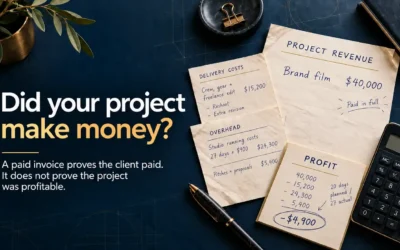
How Do I Know If a Project Made Money?
A paid invoice proves the client paid but doesn’t prove the project made money. Here is what the usual checks miss, and where a fully paid project quietly bleeds cash.
5 Hidden Margin Leaks Destroying $1M Service Businesses
Many service businesses hit $1M in revenue only to discover cash flow remains tight, delivery pressure keeps increasing, and the founder is still absorbing operational gaps personally. This article breaks down the five hidden margin leaks quietly destroying profitability during execution.

Why Does My Business Feel Harder As It Grows?
The business is growing. So why does it feel harder to run?
More clients. More revenue. More team. And somehow, more of everything still routes back to you.
Growth was supposed to create leverage. Instead it created pressure.
This article breaks down why that happens and what needs to change before scaling makes it worse.
