

5 Signs a Client Can Actually Afford You
Picture this:
You get the inquiry.
You feel the spark.
The work is interesting.
The client sounds serious.
You scope the project.
You build the proposal.
You price it carefully.
Then the negotiations start.
Small questions at first.
Then adjustments.
Then “what if we…”
Then “can we remove…”
Then silence.
Then more back and forth.
By the time the project is approved (or worse, not approved), you are already exhausted and dreading the project before it even begins.
That exhaustion is not a personality issue.
It is often the first signal that the client cannot actually afford the work.
CPS Insight
Pricing tension often shows up as negotiation fatigue long before money is discussed directly.
Affordability isn’t about what a client says. It’s about what their business behavior reveals.
Most pricing tension doesn’t come from clients being “cheap.” It comes from misreading buying signals and mistaking interest for capacity.
A client can love your work, want you badly, and still not be able to afford you.
These are 5 signs a client can afford you, so you can spot them early, before pricing becomes a problem.
What Affordability Actually Is
Affordability isn’t about what a client says. It’s about what their business behavior reveals.
Most pricing tension doesn’t come from clients being “cheap.”
It comes from misreading buying signals and mistaking interest for capacity.
It's not about enthusiasm.
It is not about the client not liking your work.
It is not about wanting the result.
It is about whether a business can absorb the decision without transferring pressure to you.
A client can respect your expertise, value your work, and still not be able to afford you.
That is not an insult. It is a mismatch.
And mismatches always surface during pricing and negotiation.
These are 5 signs a client can afford you, so you can spot them early, before pricing becomes a problem.
1. They Ask About Outcomes, Not Discounts
Clients who can afford you focus on results.
They ask:
-
What changes after this is done?
-
What does success look like?
-
How does this fit into the bigger picture?
Clients who cannot afford you focus on cost first.
Not because they are difficult.
But because price is the constraint they are trying to manage.
And affordability shows up in where attention goes.
2. They Respect the Process Without Trying to Rewrite It
Clients with financial capacity do not need to micromanage or control every step.
They want clarity, timelines and structure.
When a client tries to renegotiate the process before understanding it, they are often trying to reduce risk they cannot absorb.
That risk usually shows up later as scope creep, delivery pressure, or payment tension.
CPS Reality Check
When clients can’t absorb uncertainty, they try to transfer it.
Pricing and scope are usually where it lands.
3. Decisions Do Not Require Endless Justification
Clients who can afford you do not need prolonged reassurance.
They may ask thoughtful questions.
They may take time to decide.
But they don't need you to defend your price repeatedly.
When negotiations feel exhausting, it is rarely about persuasion or trust.
It is about capacity and whether the cost fits their reality.
4. Their Business Has Room for the Work
Affordability is structural.
Clients who can afford you already have:
-
Budgets allocated
-
Timelines that allow proper delivery
-
Space to absorb iteration or delay
Clients who cannot afford you often need the work to fix a cash problem, not support a strategy.
That pressure shows up immediately.
And it usually shows up on you.
5. They Don’t Ask You to Carry Their Risk
CPS Insight
When pricing is asked to carry risk, profit disappears even if the work is good.
The Reframe That Changes How This Feels
What Changes When Structure Is In Place
Stop Letting Negotiations Drain You Before Work Even Starts
Exhausting pricing conversations are not a communication problem.
They are usually a signal of misalignment that structure would have revealed earlier.
The Profit Baseline helps you build pricing and delivery structures that filter misaligned clients before negotiations spiral, so pressure does not start before the project does.
About the Author
Temi is a Fractional COO and Profit Architect at Creative Profit Solutions. She helps founder-led businesses experiencing financial pressure, operational chaos, margin erosion, and constant firefighting stabilize their pricing and delivery systems. Her work closes the gap between Financial Intent (what a business bills) and Operational Reality (the cash it actually keeps), so founders stop subsidizing delivery with unpaid time and personal cash.
Recent Articles:
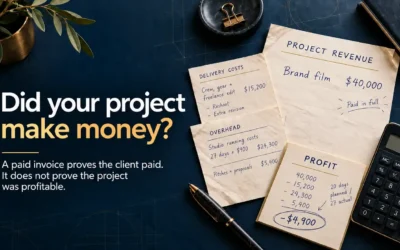
How Do I Know If a Project Made Money?
A paid invoice proves the client paid but doesn’t prove the project made money. Here is what the usual checks miss, and where a fully paid project quietly bleeds cash.
5 Hidden Margin Leaks Destroying $1M Service Businesses
Many service businesses hit $1M in revenue only to discover cash flow remains tight, delivery pressure keeps increasing, and the founder is still absorbing operational gaps personally. This article breaks down the five hidden margin leaks quietly destroying profitability during execution.

Why Does My Business Feel Harder As It Grows?
The business is growing. So why does it feel harder to run?
More clients. More revenue. More team. And somehow, more of everything still routes back to you.
Growth was supposed to create leverage. Instead it created pressure.
This article breaks down why that happens and what needs to change before scaling makes it worse.
