
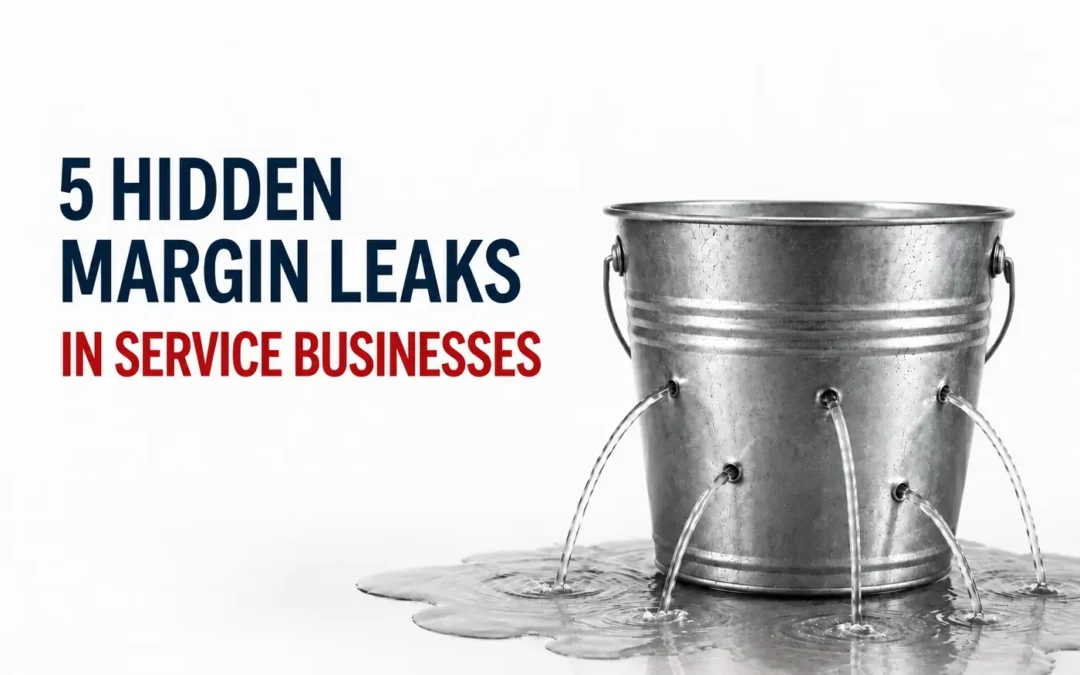
Margin leaks are operational conditions that cause projects to cost more to deliver than they were priced to recover. They usually appear through delivery delays, scope creep, unrecovered overhead, founder intervention, and unstable execution.
- 01Why revenue growth can still create financial pressure
- 02The 5 operational leaks quietly absorbing profit during delivery
- 03What needs to change to stop founder subsidy and recover margin
The Owner Subsidy
Before naming the 5 hidden margin leaks, it is important to name what they produce.
If you are skipping your own salary to meet payroll, reducing distributions to stabilize cash flow, or absorbing operational pressure personally to keep delivery moving, you are subsidizing the business.
This is the Owner Subsidy.
One of the clearest indicators of structural fragility inside a service business.
From the outside, delivery still appears healthy.
Projects move.
Clients stay satisfied.
Revenue continues entering the business.
Internally, the founder is absorbing operational and financial gaps that the business structure cannot carry on its own.
A business can appear stable externally while the founder quietly absorbs the operational pressure underneath it.
Where Profit Actually Starts Breaking
Most service businesses assume profitability problems begin with pricing or sales, but many begin during delivery.
Projects take longer than expected.
Additional revisions appear.
Operational overhead keeps running.
Founders step in to stabilize execution.
The business stays busy, but the margin slowly disappears underneath delivery.
The 5 hidden margin leaks below are some of the most common operational conditions responsible for that erosion.
Margin Leak #1: Execution Variance
Most projects are priced around ideal delivery conditions.
Clear briefs.
Controlled revisions.
Stable timelines.
No major operational surprises.
But in reality, delivery rarely behaves that way.
Projects drift.
Coordination expands.
Senior involvement increases.
Unexpected complexity appears after the sale.
The gap between the estimated and actual delivery cost is Execution Variance.
And in many service businesses, it becomes chronic.
A project estimated at 80 hours requires 115.
The client still pays the original invoice, but the additional labor gets absorbed internally through reduced margin, tighter cash flow, and increased founder involvement.
Pricing survives the proposal stage.
Profit survives delivery.
Margin Leak #2: Unrecovered Overhead
Not all operational labor reaches an invoice.
A substantial percentage of working hours disappears into delivery support activity, such as:
- internal coordination
- management oversight
- project realignment
- communication loops
- admin handling
The salaries and business overheads still run regardless of whether work is produced or not.
So when projects stretch beyond plan, those operational costs continue accumulating underneath delivery.
A project timeline extends by two additional weeks.
The client sees minor delay, but the business continues carrying payroll, management time, software overhead, coordination load, and delivery administration the entire time.
If the client is not billed for the extra time and costs, the business simply absorbs it.
Operational overhead does not disappear simply because it was never billed.
Margin Leak #3: Scope Seepage
Margin erosion usually comes from small delivery decisions accumulating across many projects.
An extra revision.
A quick adjustment.
Additional support after sign-off.
A deliverable expanded informally to keep the client happy.
Individually, these decisions feel manageable, but collectively, they create substantial unrecovered labor.
In project management, uncontrolled scope creep has consistently been linked to cost overruns, resource strain, and delivery instability.
As timelines expand, the operational cost of carrying the project expands with it.
A project quoted for 100 hours eventually becomes 130 or 140 hours of actual delivery effort.
The invoice stays the same, but the labor and overheads don't.
Every additional delivery request carries operational cost whether the business recovers it or not.
Margin Leak #4: Founder Absorption
This is usually the leak that founders feel most personally.
Projects move faster once you get involved.
Escalations route back to you.
Delivery problems continue finding their way onto your plate.
At first, it feels responsible, but over time, it becomes expensive.
Because the business slowly becomes dependent on you compensating for operational gaps in delivery.
You planned to lead the business strategically.
Instead, large parts of your week disappear into rescuing delivery.
And because the work still gets done, the underlying operational problems remain unresolved.
Founder involvement often hides operational instability instead of correcting it.
Margin Leak #5: Reactive Capacity Planning
Many service businesses hire reactively.
Pressure increases. Projects pile up.
The team starts feeling overloaded.
So someone gets hired.
Then a few months later, delivery slows down and overhead suddenly feels heavy again.
Without a clear delivery capacity model, it becomes difficult to predict:
- how much work the team can realistically carry
- when hiring is actually necessary
- whether new revenue can be delivered profitably
When the business swings between overload and underutilization, both conditions absorb margin.
The team remains overloaded because hiring decisions happen too late.
Or the opposite happens. A business hires based on pressure instead of delivery data.
In both cases, the business absorbs avoidable operational strain, and overhead costs become difficult to sustain a few months later.
More projects flowing into a structurally unstable delivery system increases the rate of margin erosion.
What Usually Happens Next
When financial pressure builds inside a service business, the instinct is usually to chase more revenue.
But additional volume flowing through a delivery system already under strain usually increases the pressure underneath it.
The leaks scale with the revenue.
At some point, the business needs visibility into what delivery is actually costing to sustain.
That means understanding:
- what the work was priced to recover
- what delivery actually required
- where margin is breaking
- what operational conditions are absorbing it
Without that visibility, founders keep compensating for the same structural gaps repeatedly.
Usually with their time, their energy, and their finances.
If growth increases operational pressure faster than profitability,
the business is absorbing costs the pricing structure was never built to carry.
Delivery pressure always leaves a financial trail.
The two-minute Profit Risk Assessment shows where your business is exposed.
Find Out in 2 MinutesFrequently Asked Questions
What are margin leaks in a service business?
Margin leaks are operational conditions that cause projects to cost more to deliver than they were priced to recover. They usually appear through delivery delays, scope creep, unrecovered overhead, founder intervention, and unstable execution.
Why does profit disappear during delivery?
Most service businesses price projects around expected delivery conditions. When timelines expand, revisions increase, overhead continues accumulating, and founders step in to stabilize execution, the business absorbs additional operational cost during delivery.
What is Founder Absorption?
Founder Absorption happens when the owner repeatedly steps in to solve delivery problems, manage escalations, rescue timelines, or stabilize operations manually. Over time, the business becomes dependent on founder intervention to keep delivery moving.
How does scope creep affect profitability?
Scope creep expands the amount of work being delivered without increasing the revenue attached to the project. As timelines extend, labor and operational overhead continue accumulating underneath delivery, reducing margin on the project.
Why do profitable-looking projects still create cash flow pressure?
Projects can appear profitable at the point of sale while absorbing additional labor, overhead, revisions, delays, and operational strain during execution. The gap between Pricing and Operational Reality creates pressure long before it becomes visible in reports.

About Creative Profit Solutions
Creative Profit Solutions works with owner-led businesses to close the gap between their pricing and their operational reality, so more of the profit in every quote ends up as cash in the bank.
Founded by Temi, whose background spans accounting, operations and white-label apparel manufacturing, it gives owners experiencing cash flow pressure, operational chaos and founder overwhelm the structure to plug hidden profit leaks and keep more of what they earn.
