
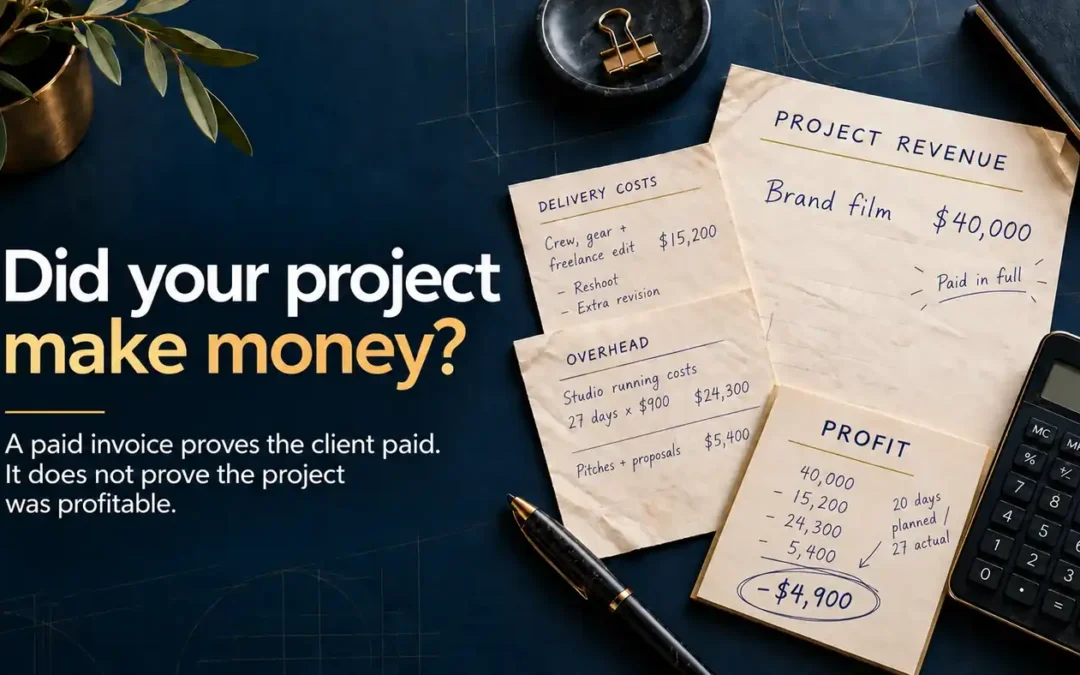
A project makes money only if its price exceeds what delivery actually cost, including every extra day the project ran past its plan.
A paid invoice proves the client paid. It does not prove the project was profitable.
- 01Why a fully paid project can still lose money
- 02What the usual checks miss
- 03A worked example from a video production company
- 04Three areas where businesses lose money after the sale
- 05What to settle before the next project starts
Paid Is Not the Same as Profitable
When a project wraps up, the focus typically moves toward the client settling the final invoice. When the invoice clears, the project feels like a win.
However, the invoice only confirms the revenue that came in. It says nothing about the actual costs incurred while the work was being delivered: the extra days, the additional revision rounds, and the hours you personally spent stepping in to keep the project on track.
So while a project can be paid in full, it might still have cost the business more than it brought in. Nothing on the invoice will show you that.
What the Usual Checks Miss
Most owner-led businesses rely on one of three signals to judge if work is profitable. Each answers a different question.
- The bank balance shows cash on a given day. However, since deposits from one project can cover the costs of another, a healthy balance can hide a project that lost money.
- The profit and loss statement shows the whole business, usually after the month or year has closed. Although it can split revenue by service line, it doesn't show which project made money and which didn't, because overheads and the owner's time are rarely split per project.
- A happy client shows the work was good. But over-delivery often produces the happiest clients and the thinnest margins.
These are useful measures, but none of them sets what a project was priced to recover against what it actually cost to deliver.
Until you make that comparison, profitability is an assumption.
Your accountant reports the outcome after the year closes.
Your pricing decided that outcome before the project began.
Worked Example:
A Video Production Company
Take a corporate video production company quoting a brand film. Before the client signed, the studio spent six days on pitches and proposals.
The fee is $40,000, and the plan is 20 working days from pre-production to final delivery, with two rounds of revisions.
The studio runs several projects and service lines at once, and each one carries its share of the cost of keeping the business open: salaries, rent, equipment, software.
For this film, that share comes to about $900 for every working day the team spends on it. That cost does not stop when a project runs long.
Midway through, the client asks for a third round of changes, which brings a half-day reshoot and four more days in the edit suite. Then final approval sits with the client's leadership team for a week.
It is easy to assume the wait costs nothing, especially when the team has other projects to work on. But the business is losing money that week.
The running costs don't pause when a project stalls, but that project's contribution to them does. The profit from the other active jobs covers the gap, subsidizing a project stuck in limbo.
In total, the film takes 27 working days instead of 20. The client loves it and pays in full. But at what cost?
| Planned | Actual | |
|---|---|---|
| Fee received | $40,000 | $40,000 |
| Crew, gear and freelance edit | $14,000 | $15,200 |
| Cost of running the studio (20 days vs 27) | $18,000 | $24,300 |
| Time spent on pitches and proposals | not counted | $5,400 |
| Result | $8,000 profit | −$4,900 |
Figures are illustrative, not drawn from a specific company.
A $4,900 loss, absorbed by the business, on a project that was meant to earn $8,000.
3 Areas Where Businesses Lose Money After the Sale
- Time beyond the plan. Every day past the planned finish carries the cost of running the business, whether or not anyone bills for it. A project priced for 20 days that runs 27 pays for those seven days out of its own profit. Overruns like this are common: in the Project Management Institute's 2018 Pulse of the Profession survey, 52% of completed projects experienced scope creep.
- The owner's unpaid hours. When the founder steps in to review cuts, calm a client or rescue a deadline, that time is a real cost. It rarely appears on any report, so the project looks healthier than it actually was. (More on this in Why Your Business Cannot Run Without You.)
- Slow payment. A project paid 60 days after delivery has to be funded by the business in the meantime. In the Federal Reserve's 2024 Small Business Credit Survey, 51% of employer firms cited uneven cash flows as a financial challenge. The cash pressure arrives first and the profit later, which is how a business ends up making money but short of cash.
A project is not finished when the invoice is paid.
It is finished when you know what it cost to deliver.
Why This Matters Before the Next Quote
If you never measure whether a project made money, the next price is built on the same assumptions as the last one.
The extra days, the unpriced pitching and the owner's hours repeat on every project, and revenue grows while the margin does not. This is one of the patterns behind a business that is busy but not profitable.
Knowing the real result of past projects is what makes the next price defensible. It turns pricing from guesswork with an invoice attached into a decision you can stand behind.
What to Settle Before the Next Project Starts
The loss in the example was decided before the first day of work. Four questions, answered before you quote, close most of that gap:
- What does this work cost you to deliver, not just to produce? Include the cost of keeping the business running while the project is live.
- How long will it really take? Price the timeline you expect, not the one you hope for.
- What is included, in writing? The number of revision rounds, the approval timeline, and what happens when either runs over.
- What did it cost to win? If pitching and proposals take weeks, that time belongs in the price.
A price that answers these four questions doesn't depend on delivery going perfectly.
Did your last project make money, or just get paid?
The two-minute Profit Risk Assessment shows where your business is exposed.
Find Out in 2 MinutesFrequently Asked Questions
How do I know if a project actually made money?
Compare what the project was priced to recover with what delivery actually cost. That includes direct costs, the cost of running the business for every day the project ran, and the time spent winning it. If the price does not cover all of that, the project lost money, even if the invoice was paid in full.
Why does a fully paid project still lose money?
Because the price was fixed before delivery began, and delivery took more than the price allowed for. Extra revision rounds, delays and owner involvement add days and costs that no one invoices. The client pays the agreed fee, and the business absorbs the difference.
Isn't my profit and loss statement enough to tell me?
A profit and loss statement shows how the whole business performed over a period, usually after it has closed. It can split revenue by service line, but it rarely shows which projects made money and which lost it, because overheads and the owner's time are seldom split per project. Profitable work can hide unprofitable work until the overall numbers start to slip.
What costs do project prices usually leave out?
The most common gaps are the cost of running the business while the work is delivered, the days a project runs beyond its plan, the time spent pitching and preparing proposals before a client signs, and the owner's own hours spent keeping projects on track.
How often should I check whether projects are profitable?
At the close of every project, and before the next quote goes out. Checking once a year shows the damage after it has happened. Checking per project shows which prices need to change while there is still time to change them.

About Creative Profit Solutions
Creative Profit Solutions works with owner-led businesses to close the gap between their pricing and their operational reality, so more of the profit in every quote ends up as cash in the bank.
Founded by Temi, whose background spans accounting, operations and white-label apparel manufacturing, it gives owners experiencing cash flow pressure, operational chaos and founder overwhelm the structure to plug hidden profit leaks and keep more of what they earn.
