

Why a “Good Year” Might Lead to a Tight Start Next Year
A good year does not guarantee a strong start next year.
Revenue can come in. Clients can be served. Work can get delivered.
From the outside, everything looks healthy.
But a good year is not defined by activity.
It is defined by what the business can carry forward without you propping it up.
That is where many capable businesses misread the year they just had.
A good year only matters if it leaves the business stronger, not just you more exhausted.
When a “Good Year” Is Powered by Effort, Not Structure
Most people describe a good year like this:
-
Work stayed consistent
-
Demand did not slow
-
Problems were handled as they came up
What rarely gets examined is how those problems were handled.
In many businesses, a good year is held together by:
-
You absorbing extra work instead of correcting the system
-
Pricing stretching quietly to cover added time, revisions, or decisions
-
Processes held together by habit instead of intention
The business performs because you compensate.
That can work short-term, but it creates fragility long-term.
Why This Shows Up as a Tight Start to the New Year
A good year often ends with:
-
Reviews that never happened
-
Pricing that was not revisited
-
Inefficiencies carried “just until things slow down”
Nothing breaks in December because momentum is still there.
But when the calendar turns:
-
Capacity resets
-
Buffers disappear
-
Postponed decisions come due
The business does not suddenly struggle.
It simply loses the extra effort that was holding everything together.
That is why January often feels tighter than expected, even after a good year.
It is the same pattern behind being fully booked but not profitable.
The One Review That Changes How You Read Last Year
Before planning next year, pause and do this.
Write down three things that increased this year but were never intentionally priced for:
-
Extra revisions or refinements
-
Longer delivery timelines
-
Increased admin, coordination, or follow-ups
-
More decision-making or emotional labor
Now ask one question:
If this repeats next year, does my pricing actually support it?
If the answer is no, the year was unsupported.
CPS Insight
Growth without structural support doesn’t compound. It drains.
December Is Where the Pace for Next Year Is Set
December is when many businesses quietly borrow from the future.
You push to finish before the holidays.
You accept timelines you would normally decline.
You delay decisions because “the year is basically over.”
Nothing feels urgent.
Those choices do not disappear.
They roll forward and show up as pressure in January.
What to Do Before the Calendar Turns
About the Author
Temi is a Fractional COO and Profit Architect at Creative Profit Solutions. She helps founder-led businesses experiencing financial pressure, operational chaos, margin erosion, and constant firefighting stabilize their pricing and delivery systems. Her work closes the gap between Financial Intent (what a business bills) and Operational Reality (the cash it actually keeps), so founders stop subsidizing delivery with unpaid time and personal cash.
Recent Articles:

How Do I Know If a Project Made Money?
A paid invoice proves the client paid but doesn’t prove the project made money. Here is what the usual checks miss, and where a fully paid project quietly bleeds cash.
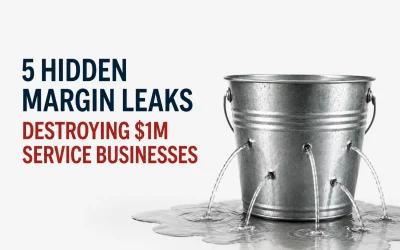
5 Hidden Margin Leaks Destroying $1M Service Businesses
Many service businesses hit $1M in revenue only to discover cash flow remains tight, delivery pressure keeps increasing, and the founder is still absorbing operational gaps personally. This article breaks down the five hidden margin leaks quietly destroying profitability during execution.

Why Does My Business Feel Harder As It Grows?
The business is growing. So why does it feel harder to run?
More clients. More revenue. More team. And somehow, more of everything still routes back to you.
Growth was supposed to create leverage. Instead it created pressure.
This article breaks down why that happens and what needs to change before scaling makes it worse.
