
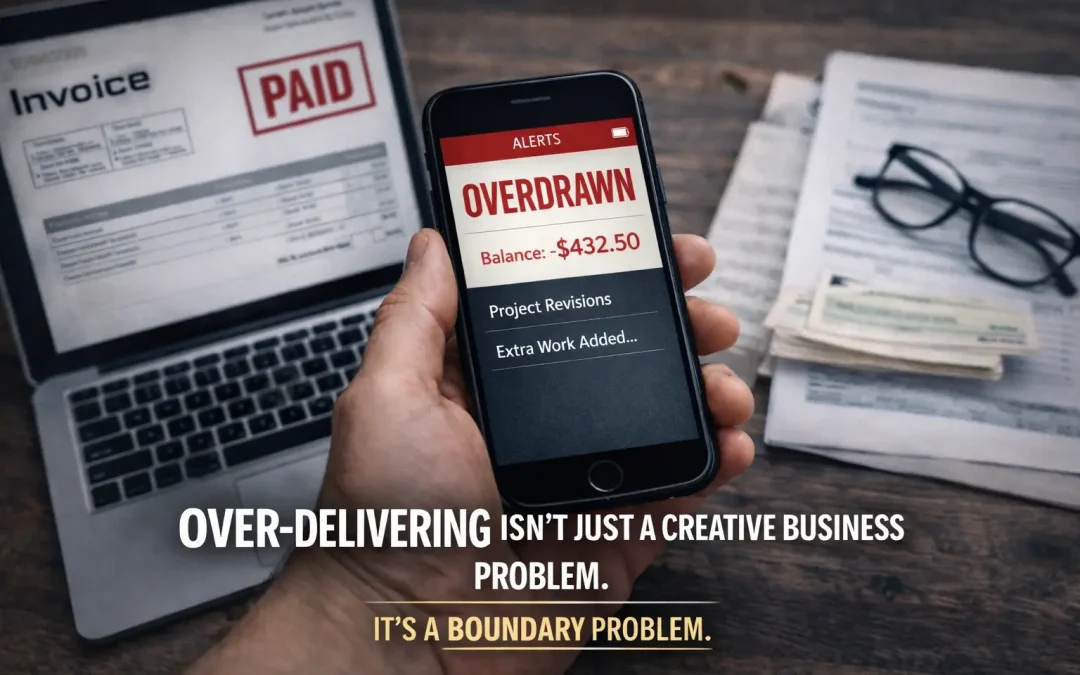
Why Over-Delivery in Creative Businesses Is a Boundary Problem, Not a Quality Problem
Over-delivery in creative businesses rarely looks like a mistake while it’s happening.
You finish the project and feel it immediately.
The client is happy.
The work looks good.
The invoice is paid.
And yet something feels off.
You are more tired than you expected.
The profit you thought would be there is thinner than it should be.
You are already behind before the next project even starts.
That disconnect is not because you lack discipline.
It is not because you are too nice.
And it is not because your standards are too high.
It is because over-delivery quietly turned paid work into unpaid labor.
The Moment Over-Delivery Actually Starts
Over-delivery does not begin with a big decision.
It starts small.
A tweak that was not in scope.
An extra refinement you know the client will never ask for.
A “let me just clean this up” at the end of a long day.
You do it because you care.
Because the work represents you.
Because nothing explicitly tells you not to.
So quality steps in where boundaries are missing.
And quality is expensive.
Over-delivery is what happens when quality is forced to compensate for missing boundaries.
Why This Keeps Happening in Creative Businesses
Most creative businesses believe over-delivery is a personal trait.
“I just have high standards.”
“I like to go above and beyond.”
“That’s how I differentiate.”
In reality, over-delivery is a system failure.
It happens when there is no clear line between:
-
what is included
-
what is optional
-
what requires a pause, review, or change in scope
When that line is missing, every decision gets made during delivery.
And decisions made during delivery always cost more.
What Boundaries Actually Are (In Real Terms)
Boundaries are not about attitude.
They are not about confidence.
They are not about being firm with clients.
Operationally, boundaries mean:
-
what the work includes
-
what it does not include
-
what happens when something new comes up
-
who decides and when
If none of that is defined, delivery expands by default.
And pricing is asked to absorb it.
If delivery decisions are happening in real time, boundaries already failed.
How Over-Delivery Turns Into Execution Drag
When boundaries are missing:
-
refinements multiply
-
decisions pile up
-
timelines stretch
-
attention fragments
None of that shows up on the invoice.
So profit absorbs the difference.
Then the owner takes over when profit and cash are drained.
This is how businesses stay busy and still feel underpaid.
Not because the work is bad.
Because the system allows effort to expand unchecked.
A Lived Example You Will Recognize
In creative work, this shows up all too often.
One extra step added “for quality.”
One more pass added “just to be safe.”
One additional adjustment no one priced for.
Each choice feels responsible in isolation.
But together, they:
-
slow delivery
-
increase handling
-
add coordination
-
create rework risk
The client sees no difference.
The business absorbs all of it.
That is execution drag in action.
When “Good Enough” Becomes Too Much
In an agile economy, the risk isn’t change.
The risk is absorbing change without a decision point.
The Triggers That Tell You Your Prices Have Stopped Holding
What a Functional System Actually Does
A Quick Example
A functional system doesn’t block change.
It prevents change from slipping in unnoticed.
Why This Matters More Than Perfection
The Shift That Reduces This
Why You Should Address It Now
Stop Letting Delivery Drain Your Profit
If this problem is already active, every project delivered without fixing it tightens capacity and pushes the cost onto you
The Profit Risk Assessment™ is a free diagnostic that identifies exactly which structural signals are active in your business right now, including whether over-delivery is a symptom of a deeper pricing or delivery structure problem.
About the Author
Temi is a Fractional COO and Profit Architect at Creative Profit Solutions. She helps founder-led businesses experiencing financial pressure, operational chaos, margin erosion, and constant firefighting stabilize their pricing and delivery systems. Her work closes the gap between Financial Intent (what a business bills) and Operational Reality (the cash it actually keeps), so founders stop subsidizing delivery with unpaid time and personal cash.
Recent Articles:

How Do I Know If a Project Made Money?
A paid invoice proves the client paid but doesn’t prove the project made money. Here is what the usual checks miss, and where a fully paid project quietly bleeds cash.
5 Hidden Margin Leaks Destroying $1M Service Businesses
Many service businesses hit $1M in revenue only to discover cash flow remains tight, delivery pressure keeps increasing, and the founder is still absorbing operational gaps personally. This article breaks down the five hidden margin leaks quietly destroying profitability during execution.

Why Does My Business Feel Harder As It Grows?
The business is growing. So why does it feel harder to run?
More clients. More revenue. More team. And somehow, more of everything still routes back to you.
Growth was supposed to create leverage. Instead it created pressure.
This article breaks down why that happens and what needs to change before scaling makes it worse.
