
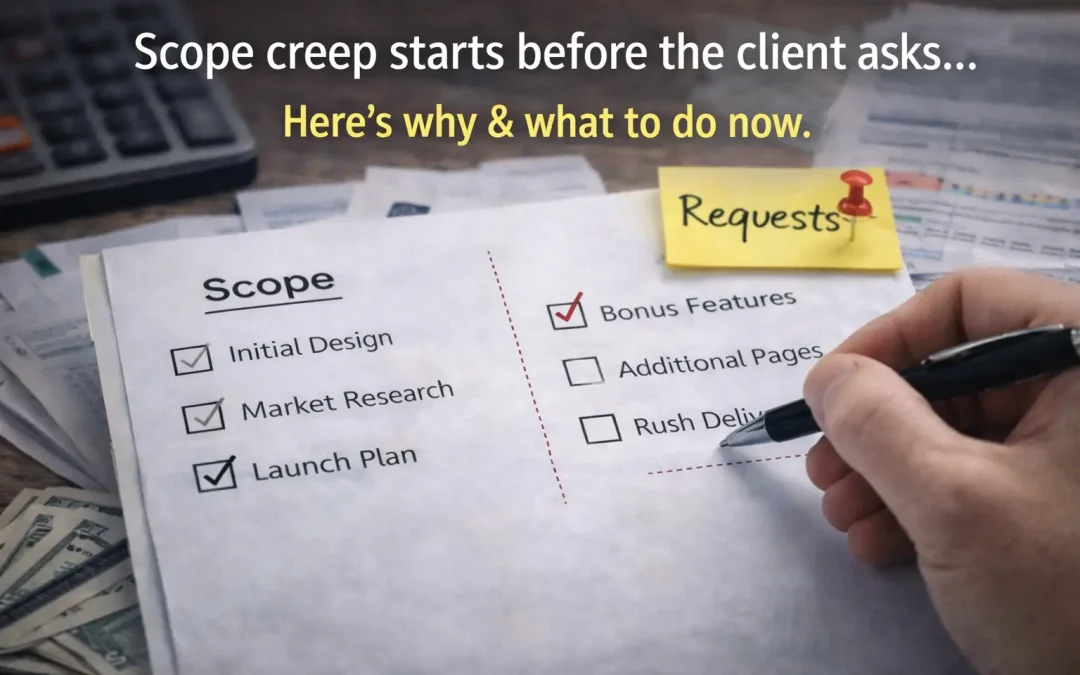
Scope Creep in Creative Businesses Starts Before the Client Asks
Scope creep rarely starts with a difficult client.
It starts with a reasonable one.
They like your work.
They trust you.
They say things like, “Can we just tweak this slightly?” or “Can we adjust this one part?”
You hesitate for half a second.
Then you say yes.
Not because you’re weak.
Because it doesn’t feel big enough to stop.
By the time the project ends, delivery feels heavier than you expected, timelines slipped quietly, and the profit you thought would be there… isn’t.
That isn’t a client problem.
That’s scope creep doing what it always does in the absence of clear guardrails.
Why Clients Keep Changing the Scope
Your clients are not trying to take advantage of you.
They are responding to the permission your system gives them.
If your scope lives in a proposal but not in your delivery process, clients will keep asking for changes because nothing tells them where the line is.
From their perspective:
-
the work feels flexible
-
you seem open
-
adjustments feel normal
From your side, each “small” change lands inside delivery.
And pricing absorbs it.
Why Scope Creep Starts Before the Client Asks
Scope creep does not begin when a client makes a request. It begins earlier.
When:
-
your scope is described but not operationally defined
-
your boundaries exist conceptually, not procedurally
-
nothing in your system forces a pause or decision
So when a client later says,
“Can we tweak this slightly?”
They are not creating scope creep.
They are stepping into a gap that already exists.
If nothing in your system defines:
-
what happens when a request falls outside scope
-
who decides
-
whether pricing or timelines are revisited
Then the default outcome is predictable.
You decide in the moment.
Delivery expands.
Pricing absorbs it.
That’s why scope creep starts before the client asks.
The request only reveals it.
Scope creep doesn’t happen because you said yes too many times.
It happens because nothing in your system tells you when to say no.
Why Saying No to Clients Feels Harder Than It Should
Saying no feels hard because you are being asked to decide under pressure.
Mid-delivery decisions are always expensive:
-
emotionally
-
operationally
-
financially
You are already deep in the work.
You don’t want friction.
You don’t want to disrupt momentum.
So you handle it quietly.
That is not a confidence issue.
It is a timing issue.
Why “Difficult Clients” Are Usually a System Problem
When your process allows work to expand without a decision point, clients will keep operating inside that flexibility.
Not because they are difficult.
Because nothing tells them otherwise.
On paper, your business absorbs the extra work.
In reality:
-
your days get longer
-
your capacity tightens
-
pressure rolls into the next project
When profit thins out, you step in to fill the gap.
That is how scope creep quietly turns good projects into draining ones.
When scope has to be managed emotionally, it was never defined structurally.
What Clear Scope Actually Looks Like in Practice
Clear scope does not mean rigidity.
It means decisions happen before delivery, not during it.
A functional scope defines:
-
what’s included
-
what’s excluded
-
what triggers a pause
-
what requires review before continuing
So when a request comes in, the system responds first.
Not your guilt.
Not your desire to keep things smooth.
Not your energy at the end of a long day.
Final Thoughts
Stop Letting Scope Creep Decide Your Margins
If this problem is already active, every project delivered without fixing it makes the work heavier and tightens your capacity.
The Profit Risk Assessment is a free diagnostic that identifies exactly which structural signals are active in your business right now, including whether scope creep is a symptom of a deeper delivery problem.
About the Author
Temi is a Fractional COO and Profit Architect at Creative Profit Solutions. She helps founder-led businesses experiencing financial pressure, operational chaos, margin erosion, and constant firefighting stabilize their pricing and delivery systems. Her work closes the gap between Financial Intent (what a business bills) and Operational Reality (the cash it actually keeps), so founders stop subsidizing delivery with unpaid time and personal cash.
Recent Articles:
How Do I Know If a Project Made Money?
A paid invoice proves the client paid but doesn’t prove the project made money. Here is what the usual checks miss, and where a fully paid project quietly bleeds cash.
5 Hidden Margin Leaks Destroying $1M Service Businesses
Many service businesses hit $1M in revenue only to discover cash flow remains tight, delivery pressure keeps increasing, and the founder is still absorbing operational gaps personally. This article breaks down the five hidden margin leaks quietly destroying profitability during execution.

Why Does My Business Feel Harder As It Grows?
The business is growing. So why does it feel harder to run?
More clients. More revenue. More team. And somehow, more of everything still routes back to you.
Growth was supposed to create leverage. Instead it created pressure.
This article breaks down why that happens and what needs to change before scaling makes it worse.
