
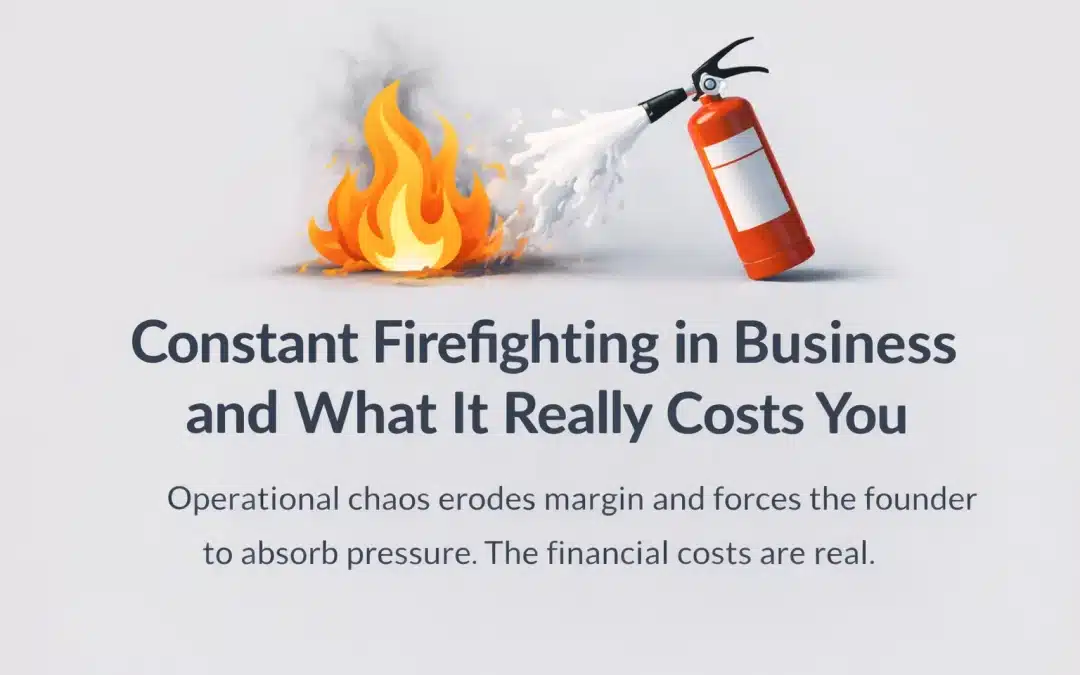
Constant Firefighting in Business and What It's Really Costing You
This article is part of The Profit Gap Series: Why revenue stops turning into cash in founder-led service businesses.
THE PROFIT GAP SERIES
Why Revenue Stops Turning Into Cash
Part 2 — You Are Here — Constant Firefighting in Business: What It's Really Costing You
I recently spent time in founder forums, project boards, and private communities reading how founders describe their problems when seeking operational support.
Not consultant jargon. Not polished marketing copy.
Their actual words and frustrations.
Across every industry, from creative agencies to fabrication shops, a pattern kept repeating, and the language was identical.
“Operational chaos.”
"Constant firefighting"
“Everything depends on me.”
“The team is busy, but nothing feels stable.”
"Not task-based but real execution"
If any of those statements feel uncomfortably familiar, you are not alone.
At first glance, it looks like a hiring problem.
But if you read carefully, these founders are not asking for another set of hands.
They are asking for execution stability.
Because once a business reaches a certain stage, the real problem is rarely effort.
It's structure.
When execution depends on the founder to keep work moving, the business enters a cycle of constant firefighting.
Problems appear faster than systems can absorb them.
And the founder becomes the filter that keeps everything from breaking.
Firefighting Is Not a Personality Trait
If you are constantly stepping in to fix things, that is not leadership intensity.
It is a sign of structural instability.
Work slows until you intervene.
Decisions wait for you.
Problems stack until you personally fix them.
The business runs.
But only because you keep catching what falls through.
You are not managing a stable system.
You are managing reactions.
CPS Reality Check
When execution relies on founder intervention,
inefficient systems hide inside urgency.
The Forensic Cost of Chaos
Firefighting is not just stressful.
It has a direct economic and financial cost.
Every interruption creates:
-
Context switching
-
Rework
-
Delayed billing
-
Extended delivery time
If a $50,000 engagement runs three weeks longer than planned because of internal corrections, overhead does not pause.
Payroll continues.
Software continues.
Rent continues.
No one invoices for chaos.
You absorb it.
This is how operational chaos quietly becomes margin erosion.
If you are also experiencing high revenue but little profit, the connection is not accidental.
See how delivery drift destroys margin here.
CPS Insight
If your day is unpredictable, your margin probably is too.
Why Firefighting Feels Normal
You’ve adapted to it.
You solve fast.
You move quickly.
You respond before things collapse.
Speed becomes your advantage.
But speed masks instability.
The faster you fix problems, the harder it becomes to see the system creating them.
Over time, you become the shock absorber for the business.
And shock absorbers wear out.
The Math Behind Founder Absorption
Let’s quantify it.
If you spend 2 hours per day resolving issues that a stable system should handle:
2 hours × 5 days = 10 hours per week
10 hours × $150 value = $1,500
$1,500 × 4 weeks = $6,000 per month
That is $72,000 per year in direct founder absorption.
And this does not include the indirect losses from delayed delivery.
Chaos is not emotional.
It is measurable.
Why Hiring Doesn’t Automatically Fix It
Getting extra hands might look like the way out.
But if the structure behind the work is fragile, adding more people creates more noise.
More handoffs.
More corrections.
More misalignment.
More things await your approval.
This is why projects keep taking longer than estimated.
CPS Insight
If a system is unstable, adding capacity increases complexity.
The real beginning of a functioning system is extracting the tacit knowledge in the founder’s head and turning it into documented processes anyone can follow.
Most founders underestimate how much of the business lives only in their heads.
The team moves.
But the real decision logic still sits with the founder.
That realization started with something small in my own operation.
A production run that was supposed to take five days consistently took six.
That extra day wiped out most of our margin.
The problem wasn’t the price.
It was the process.
The team was improvising steps that should have been documented.
So we rebuilt the workflow and created clearer operating procedures.
Over time those systems became strong enough that the business eventually ran for two full years without requiring my presence in daily operations.
Clients interacted with the team.
Projects moved forward.
Work was delivered.
Most people had no idea who the owner was.
That didn’t happen by accident.
It took years of refining workflows, documenting procedures, and building systems that carried the weight of delivery.
That is what stable operations look like.
Not constant supervision.
A system that moves work forward without the founder absorbing the pressure.
And once you experience that stability, you realize something important:
CPS Reality Check
Most operational chaos is not caused by bad people or lazy teams.
It is caused by invisible gaps in the structure of how work moves through the business.
Until those gaps are exposed, founders keep solving the symptoms instead of the system.
This is where the Margin Leak Audit™ becomes useful.
It doesn’t try to guess the problem.
It quantifies the gap between what the work was supposed to cost and what it actually cost to deliver.
And reveals at what point profit quietly disappeared during execution.
Once that gap becomes visible, the real operational corrections become much easier to identify.
Because what feels like “constant firefighting” is rarely random.
It is usually the economic signal of a delivery system that is absorbing more time and cost than the pricing model was built to support.
Because what feels like “constant firefighting” is usually a pattern.
And patterns leave evidence.
It is compensating for gaps in the system.
What Must Change
Firefighting stops when:
- Delivery workflows are clearly defined
- Handoffs are standardized
- Scope adjustments are formalized
- Founder approvals are reduced
- Capacity is modeled against real productive hours
This is structural work, not motivational work.
You cannot will chaos away.
You must engineer it out.
The 7-Day Stress Test
would your projects continue moving at the same speed or would work stall until you returned?
If momentum depends on your presence, the business is structurally fragile.
Your margin depends on you.
And that is expensive.
Stop Absorbing the Cost of Instability
If your business feels reactive, unstable, and exhausting, the issue is not effort.
It is misalignment between pricing, capacity, and delivery mechanics.
Book your Margin Leak Audit™ and get a forensic breakdown of where execution is creating margin erosion and founder absorption.
Not ready for a full audit yet?
Take a Profit Risk Assessment
About the Author
Temi is a Fractional COO and Integrator at Creative Profit Solutions. She helps founder-led businesses experiencing operational chaos, margin erosion, and constant firefighting stabilize their delivery systems. Her work closes the gap between Financial Intent (what a business bills) and Operational Reality (the cash it actually keeps), so founders stop subsidizing delivery with unpaid time and personal cash.
Forensic FAQs
Why is my business constantly firefighting?
Constant firefighting in business usually indicates unstable delivery structures. Work slows until the founder intervenes, decisions wait for approvals, and problems stack up until the owner resolves them. The issue is rarely effort or team capability. It is usually a gap in how work moves through the business.
Why does my business depend on me so much?
Many founder-led businesses rely on tacit knowledge that only exists in the founder’s head. When workflows, decision rules, and processes are not documented, the team cannot execute independently. This forces the founder to step in repeatedly to keep projects moving.
Does hiring more people fix operational chaos?
Hiring more people rarely fixes operational instability on its own. If the underlying workflows are unclear or undocumented, adding capacity often increases complexity, misalignment, and rework instead of solving the problem.
What is founder absorption in a business?
Founder absorption occurs when the business relies on the owner’s time to compensate for operational gaps. The founder steps in to resolve issues, make decisions, and maintain project momentum. This hidden intervention often absorbs time and money that should have been protected by stable systems.
What is the first step to stabilizing operations?
The first step is diagnosing where execution diverges from the original pricing and delivery plan. By comparing billed revenue, direct costs, indirect costs, planned hours, and actual delivery time, founders can identify where margin erosion and operational instability are occurring.
Can I fix constant firefighting and operational chaos in my business myself?
Some founders attempt to stabilize operations internally. However, when delivery instability, margin erosion, and founder intervention have become normalized, the underlying patterns are difficult to see from inside the system. An external forensic review often exposes gaps between planned delivery and actual execution that internal teams overlook.
Recent Articles

How Do I Know If a Project Made Money?
A paid invoice proves the client paid but doesn’t prove the project made money. Here is what the usual checks miss, and where a fully paid project quietly bleeds cash.
5 Hidden Margin Leaks Destroying $1M Service Businesses
Many service businesses hit $1M in revenue only to discover cash flow remains tight, delivery pressure keeps increasing, and the founder is still absorbing operational gaps personally. This article breaks down the five hidden margin leaks quietly destroying profitability during execution.

Why Does My Business Feel Harder As It Grows?
The business is growing. So why does it feel harder to run?
More clients. More revenue. More team. And somehow, more of everything still routes back to you.
Growth was supposed to create leverage. Instead it created pressure.
This article breaks down why that happens and what needs to change before scaling makes it worse.
