
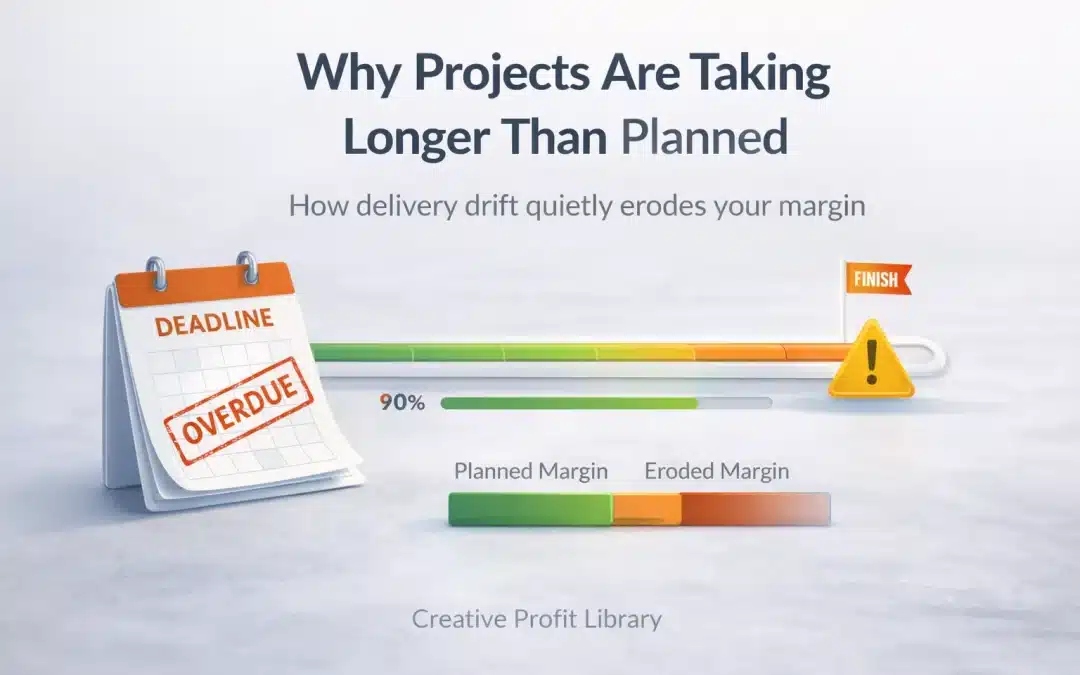
Why Projects Are Taking Longer Than Planned (And How It’s Quietly Draining Your Margin)
This article is part of The Profit Gap Series: Why revenue stops turning into cash in founder-led service businesses.
THE PROFIT GAP SERIES
Why Revenue Stops Turning Into Cash
Part 3 — You Are Here — Projects Taking Longer Than Planned? Here's What It's Costing You
In the previous article, I explained how one extra day of work nearly wiped out the entire profit on a production run.
This problem, although extremely visible in manufacturing operations, is not unique to production.
The same pattern appears in project-based businesses every day.
Quick example:
You run an agency where revenue is based on projects.
You plan the timeline.
The team agrees.
The client signs.
Then the work starts.
But everything takes longer than it should.
Not because anyone is lazy.
But because the work expands in the places no one priced, tracked, or controlled.
A review takes two days instead of one.
A handoff stalls.
A “small change” triggers another revision cycle.
The team keeps moving.
But the finish line keeps sliding.
Before you realize what’s happening, a 100-day project becomes a 120-day project.
And those extra 20 days rarely appear anywhere in your pricing model.
Worse, the extra 20 days quietly wipe out the profit you thought you had and the cash you expected to see in the bank.
Why Projects Keep Taking Longer Than Planned
When projects take longer than planned, the problem is rarely discipline.
It is usually one of three things:
-
unclear inputs at the start
-
weak handoffs inside delivery
-
founder approvals acting as the speed limit
The team stays busy.
But progress becomes inconsistent.
That inconsistency is not just frustrating.
It is expensive.
CPS Reality Check
If delivery time is unstable, profit is unstable.
The Quiet Cost of “One More Day"
Often, founders think it’s just time.
And time doesn’t feel like a real cost.
But it is.
When delivery runs longer than planned, the business pays twice.
First, you pay for the extra labor time.
Even if your team is on salary, those additional hours are still being consumed by the project.
Second, your overhead keeps running.
Rent, software subscriptions, admin costs, utilities — they continue whether the project finishes on time or not.
No one invoices for drift.
You absorb it.
Which is why revenue can stay steady while the bank account still feels tight.
Because the business keeps paying for time that was never priced.
Time another project should have been paying for if the first one had finished when it was supposed to.
That is how a profitable project quietly turns into a loss.
Related Insight:
High Revenue but No Profit? Why Your Projects Are Quietly Losing Money
The Drift Pattern Founders Miss
Most founders track the deadline.
They do not track the drift.
Drift is the gap between:
-
how long the work was supposed to take
-
and how long it actually took
That gap is where the margin disappears.
Because pricing was built on a timeline that did not hold.
Or does it happen so often that delays feel normal?
If delays feel normal, execution drift is not random.
It is structural.
A Micro Calculation That Makes This Real
Let’s keep this simple.
You priced a project assuming 80 hours.
It took 96 hours.
That is 16 extra hours.
If internal labor cost is $75 per hour: 16 × $75 = $1,200
Now add the overhead burn caused by the delay.
Two extra days of project occupancy mean overhead keeps running while capacity is blocked.
If overhead averages $400 per day: 2 × $400 = $800
This is already $2,000 of your profit spent to cover the extra costs.
Not on a spreadsheet.
In your cash.
Now add founder intervention.
4 hours stepping in to keep momentum: 4 × $150 = $600 extra
Total absorbed: $2,600.
If this happens across 10 projects, that is $26,000 quietly gone.
Why “Charge More” Is Not a Reliable Fix
A price increase can help.
But if drift remains, the new price will get absorbed too.
Because the system that creates the delay is still running.
You cannot out-price a delivery engine that expands under pressure.
What Must Change
Projects stop running late when you install guardrails that control speed.
That requires:
-
tightening what “done” means at each stage
-
standardizing handoffs so work does not stall between roles
-
reducing founder approvals so momentum does not wait for you
-
controlling revisions so drift does not compound quietly
-
matching capacity to real productive hours, not wishful scheduling
This is not a motivation issue.
It is delivery mechanics.
CPS Insight
Pricing only works when delivery behaves.
If delivery drifts, profit drifts with it.
Stop Losing Margin to Delivery Drift
If your projects consistently take longer than planned, the business is absorbing cost you never billed for.
Book your Margin Leak Audit™ and get a forensic breakdown of where execution is creating margin erosion and founder absorption.
Not ready for a full audit yet?
Assess Your Profit Risk
FAQs
Why do projects keep taking longer than planned?
Projects usually take longer than planned because delivery expands in places that were never properly defined, priced, tracked, or controlled. The most common causes are unclear inputs at the start, weak handoffs between roles, and founder approvals acting as a bottleneck.
Is it normal for projects to run late as a business grows?
No. Growth increases delivery volume, but repeated delays usually point to weak delivery controls, not normal scaling pressure. When delays become routine, the issue is structural.
What is delivery drift?
Delivery drift is the gap between how long a project was supposed to take and how long it actually took. That gap is where labor, overhead, and founder intervention start absorbing margin that was never priced into the work.
Why does “one more revision” matter financially?
Because each extra revision consumes labor hours, extends project occupancy, and keeps overhead running longer. Even small delays compound quickly and can erase the profit a project was expected to generate.
What is the fastest way to find where margin is being lost?
Start by comparing estimated delivery time against actual delivery time at each stage of the project. The point where timelines begin to expand is usually where margin leakage starts. A proper audit then identifies the root cause behind the drift.
Can I fix delivery drift myself?
You can improve parts of it internally if you tighten stage definitions, standardize handoffs, reduce approval bottlenecks, and control revisions. But if delays are recurring across multiple projects, the problem is usually structural and needs forensic review, not guesswork.
About the Author
Temi is a Fractional COO and Profit Architect who works with owner-led service and project-based businesses where revenue is consistent but profit never reaches the bank. Her work identifies the structural gaps between what a business bills and what it actually keeps — and builds the operational systems that close them. She founded Creative Profit Solutions after a decade running manufacturing operations and applying Big Four accounting discipline to the delivery economics of founder-led businesses.
Work with Temi → Get in touch
Recent Articles

How Do I Know If a Project Made Money?
A paid invoice proves the client paid but doesn’t prove the project made money. Here is what the usual checks miss, and where a fully paid project quietly bleeds cash.

5 Hidden Margin Leaks Destroying $1M Service Businesses
Many service businesses hit $1M in revenue only to discover cash flow remains tight, delivery pressure keeps increasing, and the founder is still absorbing operational gaps personally. This article breaks down the five hidden margin leaks quietly destroying profitability during execution.

Why Does My Business Feel Harder As It Grows?
The business is growing. So why does it feel harder to run?
More clients. More revenue. More team. And somehow, more of everything still routes back to you.
Growth was supposed to create leverage. Instead it created pressure.
This article breaks down why that happens and what needs to change before scaling makes it worse.
