
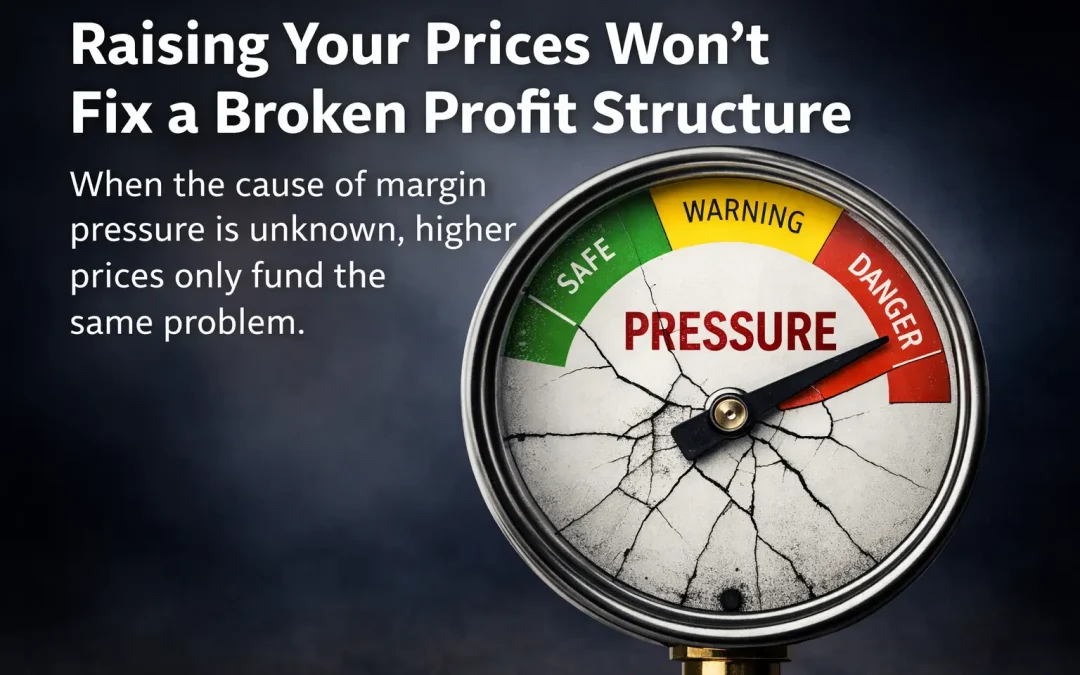
Why Raising Prices Isn't Fixing Your Profit Problem
This article is part of The Profit Gap Series: Why revenue stops turning into cash in founder-led service businesses.
THE PROFIT GAP SERIES
Why Revenue Stops Turning Into Cash
Part 6 — You Are Here — Why Raising Prices Isn't Fixing Your Profit Problem
When profit is tight, the response is almost automatic.
Increase prices.
The rationale:
If more money comes in per project, there should be more profit.
So prices go up.
And for a moment, it looks like the right move.
Until nothing actually changes.
CPS Insight
The price was set before the business fully understood what caused the tight profit in the first place.
Here Is What Actually Happens
A business starts feeling margin pressure.
Costs have increased.
Cash is slower.
Projects feel heavier than they used to.
The natural response is to raise prices, and that seems reasonable.
But the costs themselves were never fully examined.
Nobody identified what actually changed.
Nobody isolated which costs could be reduced or removed.
So the pressure was pushed into pricing instead of being corrected at the source.
Now the business is charging more.
But something else happens.
Clients at the higher price point expect more.
More responsiveness.
More involvement.
More output.
And in some cases, the business adds more to justify the increase, not formally, but in practice.
More revision rounds.
More flexibility.
More founder time.
So the cost of delivering the work increases again.
By the time the project closes, the margin that was expected from the price increase is gone.
The business did not solve anything.
It moved the pressure.
It’s that nothing underneath them changed.
The Part That Gets Skipped
Most businesses adjust pricing before diagnosing the problem.
They see the outcome.
Low profit, cash pressure, and high effort.
But they do not isolate the cause.
So the solution becomes changing the number without confirming what that number is supposed to correct.
That is not a bad instinct.
It is just incomplete.
Profit pressure does not come from one place.
Costs may have crept up without being tracked at project level.
Certain clients or project types may consistently cost more to deliver than they generate.
The business may not actually know which work is profitable and which is quietly running at a loss.
In most cases, the business has data. It just does not have visibility.
Costs are recorded.
Time is logged.
Revenue is known.
But none of it is connected clearly enough to answer the question that actually matters:
Where is profit being lost?
The Gap That Makes It Worse
Most founders cannot point to the exact moment profit started tightening.
They can feel it.
They can see the pressure.
But they cannot say with certainty when it started, what changed, or which variable caused it.
So pricing becomes the adjustment lever.
Because it is the most visible and easiest thing to change.
And the underlying causes are rarely investigated at all.
CPS Insight
If you cannot identify where profit started breaking, any price change is operating without a target.
When you increase prices without identifying the cause, the same conditions remain.
The same inefficiencies continue.
The same cost drivers stay active.
So the additional revenue gets absorbed the same way the original revenue did.
Not because charging more is wrong.
But because without knowing where the money is going, more money goes to the same place.
The Cycle That Forms
This creates a pattern that is very easy to stay stuck in.
Profit feels tight.
Prices increase.
Pressure remains.
Another adjustment is made.
Each time the business moves further away from clarity.
And closer to inconsistent margins, unpredictable performance, and ongoing founder involvement just to stabilise outcomes.
At that point, pricing is no longer a strategy.
It’s a reaction loop.
Reality check
If raising your prices hasn’t improved your financial position,
it’s not because you haven’t increased them enough.
It’s because the reason profit is being lost has not been identified.
The Question Most Founders Avoid
At this point the question is no longer whether to raise prices again.
The real question is whether the business actually knows where profit is being lost.
Because if the answer is no, every decision being made is built on unverified assumptions.
And unverified assumptions are expensive.
When the root cause is unknown, the business starts operating in a distorted way.
Prices change but outcomes do not improve.
More revenue is required to maintain the same financial position.
Decisions get made faster but with less accuracy.
The founder absorbs the gap through time and personal involvement.
This is where margin destruction becomes structural.
Not occasional.
Not situational.
But built into how the business operates.
CPS Insight
Unidentified profit loss doesn't stay contained.
It compounds.
What This Turns Into Over Time
If this continues, each new project carries hidden financial risk.
Each price increase raises expectations without fixing the issue.
Each month requires more effort to produce the same result.
Eventually the business reaches a point where revenue growth is required just to stand still.
That is not a pricing problem.
That is a system consuming its own output.
What Must Change
Before adjusting pricing again, the sequence needs to reverse.
Not: increase price and hope margin improves.
But: identify where profit is being lost, then structure pricing to account for it.
That requires isolating where costs are increasing,
understanding which work is actually profitable,
identifying where decisions and structure are distorting margin, and
connecting financial data to operational reality.
Because until the cause is clear, pricing will keep responding to symptoms instead of solving the problem.
you are not in control of your margins.
You are reacting to them.
Why This Matters Now
Most businesses do not fail because they do not generate revenue.
They fail because they never identified what was quietly eroding it.
And by the time the pressure becomes obvious, cash is tight, decisions become reactive, and options become limited.
If you don’t know where profit is breaking, you will keep adjusting the business without ever correcting it.
What To Do Next
If you cannot identify where profit started breaking, the first step is understanding whether your business is showing the structural signals of a profit leak.
The Profit Risk Assessment surfaces those signals in less than 5 minutes.
FAQs
Why isn't raising prices improving my profit?
Because price is only one variable. If the cause of profit loss is unknown, increasing prices does not remove it. It only gives that same issue more revenue to absorb.
How do I know if this is happening in my business?
If any of these are true: revenue has increased but profit hasn't, projects feel heavier at higher price points, cash doesn't reflect the level of work being delivered, or you cannot clearly explain where profit is lost, then pricing is likely not addressing the real issue.
Could this just be a cost problem?
Possibly. But most businesses don't track costs at the level required to confirm that. Costs are recorded but they are not connected to specific projects, specific clients, or actual delivery time and founder hours absorbed. So the business feels pressure but cannot isolate the source.
What if I already increased my prices recently?
That doesn't change the underlying condition. If the root cause wasn't identified first, the same factors that affected previous pricing will affect the new pricing. That is why nothing changes financially.
Why does profit pressure get worse during growth?
Because growth multiplies decisions, projects, and complexity. If the structural cause of profit loss has not been addressed, all of that additional volume runs through the same broken system. More revenue goes in. More gets absorbed. The pressure intensifies rather than easing.
Is this a pricing issue or an operational issue?
It is a visibility issue. Pricing decisions are being made without full understanding of what drives cost, time, and margin inside the business. Until that visibility exists, both pricing and operations will continue to misalign.
What will the Profit Risk Assessment actually show me?
It identifies whether your business is showing the structural signals of a profit leak based on how your business actually operates right now. Not general advice. A specific risk profile that tells you whether the conditions described in this article are present in your business and how urgent they are.
What happens if I don't address this now?
The problem doesn't stay the same. It compounds. Each new project carries the same unknown risks. Each pricing decision is still based on incomplete information. More revenue is required to maintain the same financial position. Over time this turns into increasing pressure despite growth, greater reliance on the founder to stabilise outcomes, and less room to correct the problem without disruption. The business grows, but profit does not follow.
About the Author
Temi is a Fractional COO and Profit Architect at Creative Profit Solutions. She helps founder-led businesses experiencing operational chaos, margin erosion, and constant firefighting stabilize their pricing and delivery systems. Her work closes the gap between Financial Intent (what a business bills) and Operational Reality (the cash it actually keeps), so founders stop subsidizing delivery with unpaid time and personal cash.
Recent Articles
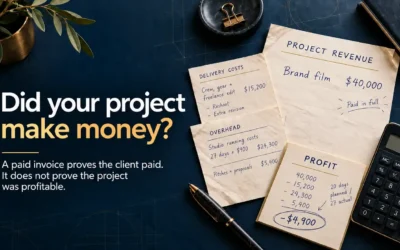
How Do I Know If a Project Made Money?
A paid invoice proves the client paid but doesn’t prove the project made money. Here is what the usual checks miss, and where a fully paid project quietly bleeds cash.

5 Hidden Margin Leaks Destroying $1M Service Businesses
Many service businesses hit $1M in revenue only to discover cash flow remains tight, delivery pressure keeps increasing, and the founder is still absorbing operational gaps personally. This article breaks down the five hidden margin leaks quietly destroying profitability during execution.

Why Does My Business Feel Harder As It Grows?
The business is growing. So why does it feel harder to run?
More clients. More revenue. More team. And somehow, more of everything still routes back to you.
Growth was supposed to create leverage. Instead it created pressure.
This article breaks down why that happens and what needs to change before scaling makes it worse.
