
What’s Really Behind Operational Chaos in Businesses?
This article is the final part of The Profit Gap Series: Why revenue stops turning into cash in founder-led service businesses.
THE PROFIT GAP SERIES
Why Revenue Stops Turning Into Cash
Part 8 — You Are Here — What's Really Behind Operational Chaos in Businesses & What It Signals
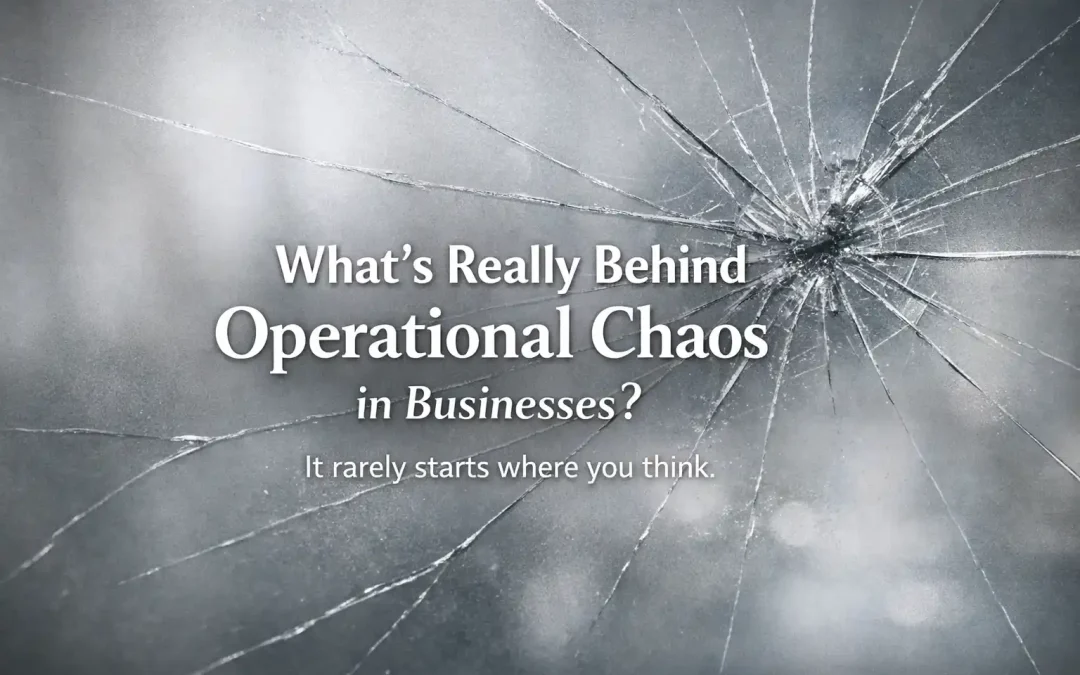
Look at this image for a moment.

The crack looks obvious.
You can see where it spread.
You can trace the damage across the surface.
It feels clear where the problem is.
But that’s not where it started.
In glass, fractures rarely begin where they become visible.
They begin at a point of weakness under the surface, long before anything breaks.
By the time the crack appears, the structure has already failed.
Operational chaos works the same way.
CPS Insight
What you can see is where the system failed visibly.
Not where it failed structurally.
The Conclusion Most Founders Reach Is Wrong
When operations feel chaotic, the conclusion is almost always personal.
You’re not organised enough.
Not disciplined enough.
Not strong enough at managing people.
Not structured enough.
So you try to fix it.
You tighten oversight.
You add more tools.
You push harder to “run things properly.”
And the chaos stays.
Because it was never a leadership problem.
It’s a structural one.
If more effort was going to fix this, it already would have.
The System Exists. It Just Isn’t Holding.
Most founders say:
“We don’t really have systems.”
But look closer.
Work is coming in.
Projects are being delivered.
Clients are being served.
Revenue exists.
There is a system.
It’s just not carrying its own weight.
It works because people are holding it together in real time.
Not because the structure is doing the work.
And that distinction is everything.
It just only works when someone is actively holding it together.
The Business Isn’t Disorganised. It’s Unsupported
What feels like chaos is usually this:
Work moves because someone pushes it.
Work completes because someone fixes it.
Work progresses because someone notices what’s missing.
Remove that person, especially the founder, and everything slows or stops.
That’s not disorganisation.
That’s a system that was never designed to operate independently.
If work only moves when someone intervenes,
the system is not operating. People are.
Where It Actually Breaks (And Why You Keep Missing It)
Operational chaos feels like one big problem.
It isn’t.
It’s two very specific failures happening at the same time.
1. Work Breaks Between People
Work moves across your business in stages.
From one person to the next.
From one function to another.
But the transitions are rarely defined.
So this is what actually happens:
- One person thinks they’re done
- The next person doesn’t pick it up
- No one owns the handoff
Work sits.
Work overlaps.
Work gets missed.
Nobody is clearly wrong.
But nothing is clearly moving either.
If no one owns the transition,
work does not move. It waits.
2. Work Breaks Inside The Tasks
Even when work does move, it often can’t be completed cleanly.
Because “done” is not defined anywhere except with you.
Only you know what good looks like.
So the team:
- interprets instructions
- delivers something close
- sends it back
- gets corrections
- repeats
That’s where the rework is coming from.
Not poor performance.
Undefined standards.
If work comes back multiple times before it’s accepted,
“done” was never clearly defined.
The Problem Isn’t Execution. It’s Missing Definition
This is where most founders finally see it.
The issue is not that work isn’t getting done.
It’s that:
- work isn’t clearly transferable
- work isn’t independently completable
So it keeps returning to the same place.
You.
it is not operationally defined.
Why It Keeps Happening
Both breakdowns come from the same root.
The knowledge required to move work forward lives inside people, not inside the system.
Usually inside the founder.
This makes sense.
You built the business.
You did the work.
You know how it should be done.
But as the business grows:
You delegate tasks.
You do not transfer the decision logic behind them.
So when something doesn’t go exactly as expected, the work comes back.
Not because the team is incapable.
Because the system was never built to handle it without you.
Delegation without decision logic
creates dependency, not capacity.
Tools Record the Problem. They Don't Fix It
When things feel chaotic, the instinct is to add tools.
Project management systems.
CRMs.
Dashboards.
And they help. But not in the way you think.
Tools track work.
They do not define it.
A task can be “in review” without anyone knowing:
- what review actually means,
- what standard it must meet,
- what happens if it doesn’t.
So the tool makes the chaos visible.
It doesn’t remove it.
Reality check
If the system cannot define the work,
the tool will only document the confusion.
What Operational Chaos Actually Is
It’s not randomness.
It’s not lack of discipline.
It’s a system that cannot carry its own load.
So the people inside it absorb the weight instead.
That’s why:
- work needs constant clarification
- tasks need repeated correction
- you step in to connect everything
Not because you have to.
Because without you, the system stalls.
CPS Insight
Operational chaos is not disorganisation.
It is uncarried load.
What This Is Quietly Costing You
This is where it turns into a business problem.
Every project carries hidden cost.
Every delay increases delivery time.
Every revision increases labour.
Every dependency increases pressure.
So even when revenue grows:
Margin erodes.
Capacity tightens.
Effort increases.
Eventually, you reach the point where:
You need more revenue just to maintain the same position.
That’s not pricing.
That’s structural failure.
If more work is required to maintain the same output,
the system is consuming its own margin.
What Actually Needs to Change
Not more tools.
Not more effort.
Not tighter control.
The structure needs to define how work behaves.
Specifically:
- What makes a task complete
- What makes work ready to move forward
- What decisions are required at each stage
- What “good” looks like — clearly enough that someone else can assess it
Once that exists:
Work moves without chasing.
Work completes without rework.
The system starts carrying the load.
And your role changes.
From the person holding everything together
→ to the person directing where it goes
It is a system that does not require constant management.
Final Insight
Operational chaos is not where the problem begins.
It’s where it becomes visible.
By the time you feel it,
you’re already looking at the symptom — not the source.
What To Do Next
If your business is facing operational chaos, it's time to examine where the structure is failing to carry the work.
The Profit Risk Assessment helps you identify if your business is showing the same structural cracks.
Just a few questions. Takes less than 5 minutes.
About the Author
Temi is a Fractional COO and Profit Architect at Creative Profit Solutions. She helps founder-led businesses experiencing financial pressure, operational chaos, margin erosion, and constant firefighting stabilize their pricing and delivery systems. Her work closes the gap between Financial Intent (what a business bills) and Operational Reality (the cash it actually keeps), so founders stop subsidizing delivery with unpaid time and personal cash.
FAQs
Why does operational chaos keep happening even when I try to fix it?
Because most fixes target symptoms, not structure. Work still can’t move between people cleanly, and it still can’t be completed without your input. Until those gaps are defined, the chaos returns.
Is operational chaos a leadership problem?
No. It’s a structural problem. It happens when the knowledge to move and complete work lives in people, not in the system.
Why does hiring more people make it worse?
Because it increases the number of handoffs and interpretations inside an undefined structure. More people amplify the gaps.
What’s the difference between busy and productive?
Busy means work is happening. Productive means work is completing cleanly and moving forward. In chaos, activity increases but output doesn’t.
Why don’t tools fix this?
Because tools track work. They don’t define what “done” means or how work should move. They make chaos visible, not resolved.
What does “operationally defined” actually mean?
Work can move between people without intervention and be completed without your interpretation. Standards and decisions are built into the system.
How do I know if it’s a structural problem and not a people problem?
If the same breakdowns keep happening in the same places, regardless of who is involved, it’s structural.
When should I consider hiring a Fractional COO?
When the problem is clear but you don’t have the time or internal capacity to fix it. A fractional COO builds the systems so the business can run without you as the safety net.
Recent Articles

How Do I Know If a Project Made Money?
A paid invoice proves the client paid but doesn’t prove the project made money. Here is what the usual checks miss, and where a fully paid project quietly bleeds cash.

5 Hidden Margin Leaks Destroying $1M Service Businesses
Many service businesses hit $1M in revenue only to discover cash flow remains tight, delivery pressure keeps increasing, and the founder is still absorbing operational gaps personally. This article breaks down the five hidden margin leaks quietly destroying profitability during execution.

Why Does My Business Feel Harder As It Grows?
The business is growing. So why does it feel harder to run?
More clients. More revenue. More team. And somehow, more of everything still routes back to you.
Growth was supposed to create leverage. Instead it created pressure.
This article breaks down why that happens and what needs to change before scaling makes it worse.
