
Where Scope Creep Really Comes From (And Why It Keeps Costing You)
This article is part of The Profit Gap Series: Why revenue stops turning into cash in founder-led service businesses.
THE PROFIT GAP SERIES
Why Revenue Stops Turning Into Cash
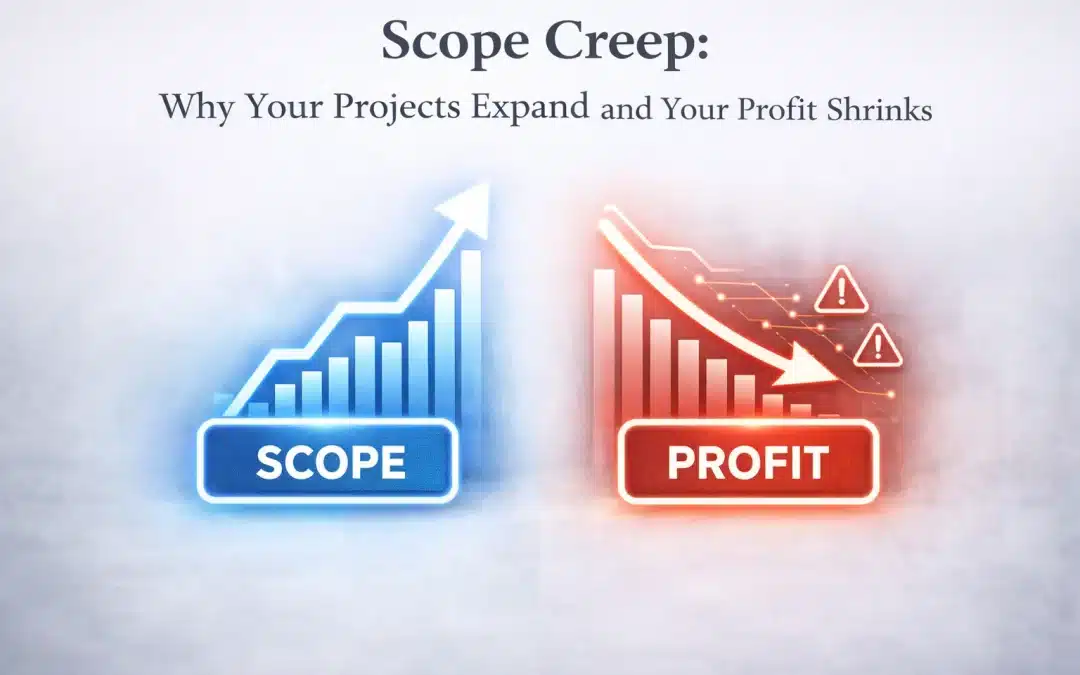
Part 7 — You Are Here — Scope Creep: Why Your Projects Expand and Your Profit Shrinks
Do your projects take longer than expected?
Do they require more effort than planned?
Do they feel harder to bring to completion than they should?
If your answer is yes, you already know there is a problem.
You can see the overrun.
You can feel the extra effort.
And what should have been easy revenue turns into a “never-ending” project.
You cannot clearly point to where it started.
And nothing looks obviously wrong on the surface.
There is no single moment where the project goes off track.
No single decision explains the overrun.
Just a gradual expansion.
That is what makes scope creep difficult to catch.
It does not arrive as a clear event.
It accumulates.
CPS Insight
Scope creep is rarely one moment.
It builds through small, never clearly defined, additions that don't stop.
The Scope Creep Version Everyone Sees
There is a version of scope creep that is easy to recognise.
The extra round after sign-off.
The additional request that was not in the brief.
The “can you add this while you are at it” that expands the deliverable.
This is the visible version.
It shows up in conversations.
It gets labelled as scope change.
It feels like the moment the project went off track.
And it does cost margin.
But even this version rarely starts where it appears.
It usually happens because the boundary was never defined clearly enough for the client to see it.
The scope says three rounds of revisions.
But what counts as a round is not defined.
The scope says a completed website.
But what “completed” includes is not specified in a way that can be measured.
So the work keeps expanding.
Not always because the client is pushing.
Because the line was never clear enough to hold.
A boundary that is not clearly defined will not be consistently respected.
The Version Almost No One Sees
This is where the real challenge lies.
What happens inside the work itself.
The extra revision that was never requested.
The adjustment that took another hour because it did not feel finished.
The additional option prepared to show thoroughness.
The final pass to improve something that already met the brief.
None of this was requested.
None of it was priced.
All of it was delivered.
This internal scope creep does not show up in emails.
It does not trigger a conversation.
It is not tracked as a change.
It simply happens.
Quietly. Repeatedly. At full cost.
And in many businesses, this is where more margin is lost.
Internal scope creep happens as a standard that was never defined.
Why the Work Keeps Expanding
Often times, especially in service businesses, completion is not clearly defined.
It is interpreted.
The work is complete when it "feels" complete.
Polished when it "feels" polished.
Ready when it "feels" ready.
So the work continues.
Past the requirement.
Past what was priced.
Past what the client needed.
Not because it had to.
Because there was nothing that clearly said it could stop.
If “done” is not clearly defined, the work will continue until time or pressure forces it to stop.
What “Done” Actually Means
In manufacturing environments, completion is not subjective.
A product is assessed against a defined specification.
If it meets the specification, it is complete.
No further improvement.
No additional refinement.
No extension based on preference.
Anything beyond that point adds cost without adding value.
Service businesses rarely operate this way.
The standard is not documented.
It sits in someone’s head.
Usually the founder’s.
So the work continues until it feels finished.
When the standard lives in people, the work continues.
When the standard is defined, the work stops.
What Internal Scope Creep Costs The Business
Internal scope creep is easy to miss because it is never labelled.
But it is consistent.
A few extra hours per project.
Across multiple projects per month.
At full labour cost.
This is the same pattern discussed in Part 3 of the Series.
Where small increases in delivery time compound into real margin loss.
That is not a small adjustment.
That is margin leaving the business.
Not from client requests.
From work that was never defined to stop.
If your projects consistently take longer than planned, the gap is not random. It is structural.
Every hour added beyond what was defined is work that is not being paid for.
The price stays the same.
The cost increases.
That gap is where profit disappears.
Why Better Boundaries Do Not Fix It
The usual advice is to tighten control.
Stronger contracts.
Clearer conversations.
More direct pushback.
But these only help with external scope creep, where there are visible requests.
It does not address self-imposed internal scope creep.
Because it does not arrive as a request, there is nothing to push back on.
And more importantly, it is easy to justify.
It is only my time.
The team is salaried, they will be paid anyway.
And time is rarely treated as a constraint because there is no visible cost to it.
So the work expands without resistance.
There is no clear point where it should stop.
Because nothing defines where it stops.
And in many cases, the client never even notices the difference in the “improved quality.”
The output already meets, and often exceeds, their expectations.
As soon as their definition of done has been met.
What the "Definition of Done" Actually Means
A Definition of Done is not a general description of the work.
It is a clear standard that defines exactly when the work stops.
Not when it feels finished.
When it meets a defined condition.
For example:
A website project is not “complete” when it looks good.
It is complete when the agreed pages are built, content is in place, and one round of revisions has been delivered.
A brand package is not “complete” when it feels polished.
It is complete when the agreed deliverables are produced and one revision cycle has been incorporated.
A strategy document is not “complete” when it could be improved.
It is complete when the defined sections are written and delivered in the agreed format.
When the Definition of Done is this clear:
The client can see the boundary.
The team can see the boundary.
And the work stops at the boundary.
Anything beyond it becomes a conscious decision.
Not something that quietly happens during delivery.
Where Scope Creep Actually Starts — And Where It Stops
The shift happens when completion is defined clearly enough that it does not rely on interpretation.
Not general language.
A specific, observable standard.
What is included.
What is delivered.
What counts as complete.
When that exists:
Client requests can be assessed clearly.
Internal additions become visible choices.
The work stops when the requirement is met.
Not when it "feels" finished.
The goal is not tighter control.
The goal is a standard that removes the need for constant judgment.
Final Insight
Scope creep does not begin with the extra client request.
It begins earlier.
Inside the work itself.
By the time it becomes visible,
the expansion has already been happening.
If you are a solo founder or leading a team, make this the standard question:
For internal work:
Is this part of our Definition of Done?
For client requests:
Is this part of the agreed scope?
If not, do not add it by default.
Assess the implications in time, cost, and impact on profit, and then decide.
What To Do Next
If scope creep is happening in your projects, it's time to check for the signals.
The Profit Risk Assessment is a short diagnostic to see whether your business is showing the patterns that lead to scope creep and margin loss. It only takes a few minutes.
FAQs
What is scope creep?
Scope creep is the gradual expansion of work beyond what was originally defined and priced. It is not always driven by the client (external scope creep). It can also build inside delivery through work that was never clearly defined (internal scope creep).
What is self-imposed internal scope creep?
It is additional work introduced by the business during delivery that was never requested or priced. It is usually justified in the moment and seen as as “just time.”
Why is internal scope creep harder to control?
Because it does not arrive as a request. There is nothing to push back on, and it is often justified as improving quality, even when the client would have accepted the original output.
Why doesn’t the client notice the difference?
Because the work often already meets their expectation. Additional refinements go beyond what was required, but not beyond what the client can recognise or value.
Why don’t contracts or boundaries fix internal scope creep?
They address external requests, not what happens inside delivery. Without a clear definition of completion, the work continues based on judgment, not structure.
What is a Definition of Done in a service business?
Work can move between people without intervention and be completed without your interpretation. Standards and decisions are built into the system.
How do I know if this is happening in my business?
If projects consistently take longer than expected, require more effort than planned, or are difficult to close out cleanly, the work is likely expanding beyond what was defined.
What changes when a Definition of Done is in place?
Work stops at a clear point. Internal additions become visible decisions, and client requests can be assessed against a defined boundary.
About the Author
Temi is a Fractional COO and Profit Architect at Creative Profit Solutions. She helps founder-led businesses experiencing financial pressure, operational chaos, margin erosion, and constant firefighting stabilize their pricing and delivery systems. Her work closes the gap between Financial Intent (what a business bills) and Operational Reality (the cash it actually keeps), so founders stop subsidizing delivery with unpaid time and personal cash.
Recent Articles

How Do I Know If a Project Made Money?
A paid invoice proves the client paid but doesn’t prove the project made money. Here is what the usual checks miss, and where a fully paid project quietly bleeds cash.

5 Hidden Margin Leaks Destroying $1M Service Businesses
Many service businesses hit $1M in revenue only to discover cash flow remains tight, delivery pressure keeps increasing, and the founder is still absorbing operational gaps personally. This article breaks down the five hidden margin leaks quietly destroying profitability during execution.

Why Does My Business Feel Harder As It Grows?
The business is growing. So why does it feel harder to run?
More clients. More revenue. More team. And somehow, more of everything still routes back to you.
Growth was supposed to create leverage. Instead it created pressure.
This article breaks down why that happens and what needs to change before scaling makes it worse.
