
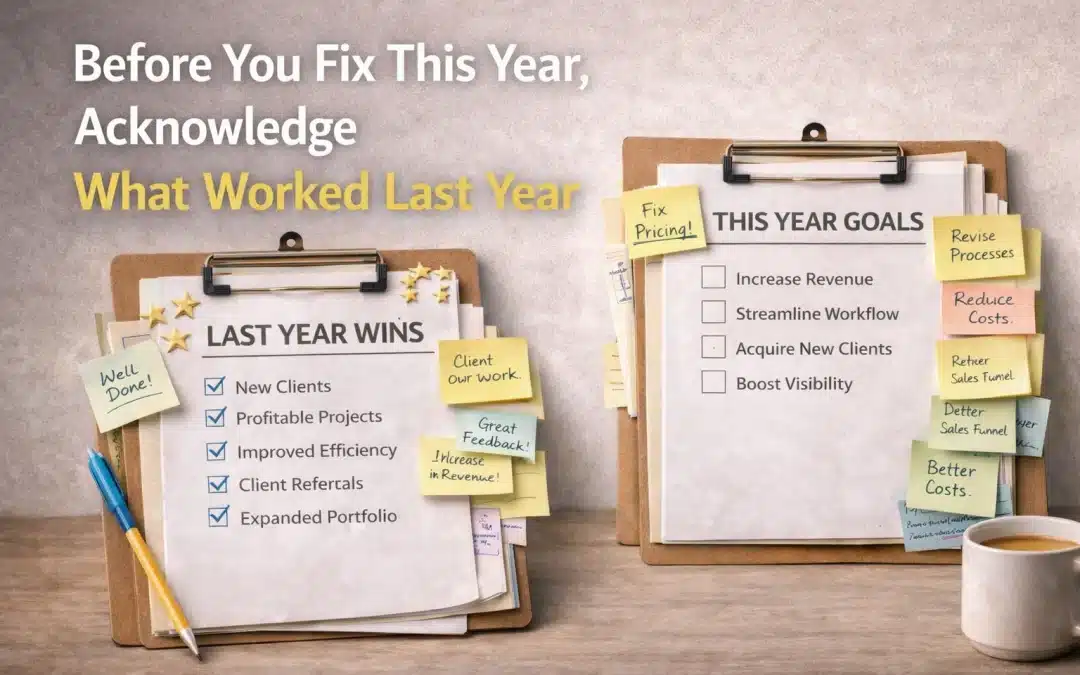
Before You Fix This Year, Acknowledge What Worked Last Year
January creates urgency.
New goals.
New plans.
New pressure to fix things quickly.
But fixing without context is how businesses break what was actually working.
Before you change anything this year, you need to understand two things clearly:
→ what held the business up last year, and
→ what quietly cost you.
Change without clarity does not improve a business.
It destabilizes it.
Why Acknowledging What Worked Is Strategic
Acknowledging what worked is not complacency.
It is diagnosis.
If your business made it through last year, then at least one thing held:
-
An offer sold reliably
-
A delivery process did not collapse
-
A pricing decision held under pressure
Ignoring that and starting from scratch introduces unnecessary risk.
You don't need a clean slate.
You need clarity on what deserves protection.
This is why a proper year-end review matters more than new ideas in January.
The 3-Question Review Most Businesses Skip
Before changing pricing, offers, or structure, answer these honestly:
→ What generated revenue without constant stress?
→ Which work felt heavy even when it was paid for?
→ Where did effort increase without improving outcomes?
This separates:
-
Stability from strain
-
Value from excess effort
-
Pricing issues from process issues
Without this step, businesses often fix the wrong thing.
If everything feels like it needs fixing, the real problem is a lack of clarity.
Why This Matters More Than Motivation
Many January changes fail for one reason.
They are driven by urgency, not understanding.
That is why you see:
-
Prices raised when process was the real problem
-
Offers scrapped that were actually fine
-
Instability created in areas that only needed support
Clarity prevents overcorrection.
You don’t improve a business by changing everything.
You improve it by reinforcing what worked, and correcting what quietly cost you.
How This Connects to Pricing
Most businesses assume pricing is the first thing to fix in January.
Sometimes it is. Sometimes, it isn’t.
A pricing review for the new year only works if you first understand:
-
What pricing actually held
-
Where it stretched
-
What it absorbed quietly
Otherwise, changes are reactive, not corrective.
This is how good years turn fragile.
What to Do With This Insight
A good year does not guarantee a stable one.
If last year worked because you compensated with extra effort, extra time, or extra tolerance, January is not asking you to change everything.
It’s asking you to see clearly what actually held and what quietly relied on you.
Because whatever was not supported structurally last year does not reset in January.
It repeats, often with less margin and less flexibility.
That’s why the smartest move at the start of the year isn’t motivation or change. It’s diagnosis.
Start the Year With Clarity, Not Guesswork
Before you adjust pricing, offers, or capacity, you need to know one thing:
What was your pricing actually carrying last year, and what will it be asked to carry again?
The Pricing Analyzer™ helps you see that clearly by showing:
-
Where pricing held
-
Where it stretched
-
Where pressure was quietly absorbed
So your next move is intentional, not reactive.
Start the Year With Clarity, Not Guesswork
If pricing has been absorbing the strain of loose delivery, the structure underneath is the problem — not the number.
The Profit Risk Assessment™ identifies exactly where your delivery structure has gaps and where pricing is being asked to carry costs it was never built to hold. It takes less than 15 minutes.
About the Author
Temi is a Fractional COO and Profit Architect at Creative Profit Solutions. She helps founder-led businesses experiencing financial pressure, operational chaos, margin erosion, and constant firefighting stabilize their pricing and delivery systems. Her work closes the gap between Financial Intent (what a business bills) and Operational Reality (the cash it actually keeps), so founders stop subsidizing delivery with unpaid time and personal cash.
Recent Articles:

How Do I Know If a Project Made Money?
A paid invoice proves the client paid but doesn’t prove the project made money. Here is what the usual checks miss, and where a fully paid project quietly bleeds cash.
5 Hidden Margin Leaks Destroying $1M Service Businesses
Many service businesses hit $1M in revenue only to discover cash flow remains tight, delivery pressure keeps increasing, and the founder is still absorbing operational gaps personally. This article breaks down the five hidden margin leaks quietly destroying profitability during execution.

Why Does My Business Feel Harder As It Grows?
The business is growing. So why does it feel harder to run?
More clients. More revenue. More team. And somehow, more of everything still routes back to you.
Growth was supposed to create leverage. Instead it created pressure.
This article breaks down why that happens and what needs to change before scaling makes it worse.
