
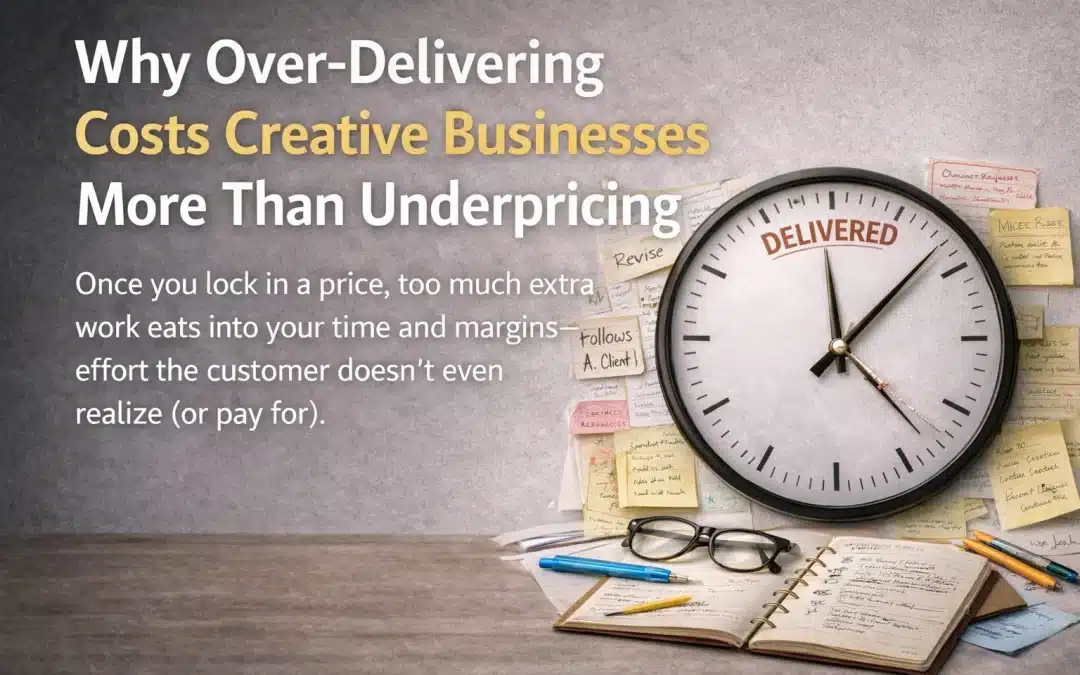
Why Over-Delivering Costs Creative Businesses
Over-delivering rarely feels like a problem while you’re doing it.
It feels like pride.
Like care.
Like giving your client your best.
That’s why so many creative businesses end up busy, exhausted, and confused about where the money went.
The client paid.
The work was delivered.
But the profit never showed up the way it should have.
Not because the price was wrong.
Because the work kept expanding after the price was locked.
Many creative businesses assume profit is decided at the pricing stage.
Once the client agrees, the money should be safe.
In reality, profit disappears during delivery, as small day-to-day decisions quietly increase cost after pricing is set.
Where Profit Actually Disappears After the Client Pays
Pricing is meant to cover delivery, meaning the full process of producing, managing, and completing the work, plus materials, time, overhead, indirect costs, and margin.
But delivery decisions decide whether that math survives reality.
Every extra step added after pricing, every refinement, every “let me just improve this,” is work you pay for, not the client.
It comes out of your margin.
Out of your time.
Out of your capacity.
That is where profit disappears, quietly, project by project, until the work feels heavier and the numbers stop making sense.
CPS Insight
Pricing doesn’t fail at the quote.
It fails when delivery expands without limits.
Indirect Costs Don’t Pause Just Because the Client Paid
Why This Matters in Real Life
When I ran a garment manufacturing unit doing white-label production for fashion designers’ ready-to-wear lines, this happened constantly.
This was not bespoke, one-off work.
This was small-batch production meant to scale.
A design would call for decorative rhinestones.
On paper, the plan was clear.
Ninety stones achieved the intended look.
The client approved it.
The price was set.
Then delivery started.
And someone, often me, would think:
“Ten more will make it feel finished.”
On a single garment, that sounds harmless.
In production, it was not.
Those ten extra stones did not mean ten more pieces of work.
They meant ten more stones per unit.
CPS Reality Check
In production, once you move beyond a single unit, every decision multiplies immediately.
To the client, there was no visible difference.
Inside the business, everything changed.
More placement time per unit.
More careful alignment.
Longer pressing and steaming.
Higher breakage risk.
More inspection.
More correction.
If the stones were hand-applied, the cost escalated fast.
What felt like a small creative upgrade became:
-
Longer production days
-
Slower throughput
-
More fatigue on the floor
-
More mistakes to fix
-
Less margin left at the end
Those ten stones were not just materials.
They were time I could not recover.
Capacity I could not replace.
Risk I had not priced for.
And when the order shipped, the client paid exactly what was agreed.
The business absorbed everything else.
That is how profit disappears in creative businesses.
Quietly. Repeatedly. At scale.
CPS Reality Check
If the client can’t see it, feel it, or benefit from it, it’s not value. It’s cost.
This Is Not About Lowering Quality
Efficiency is not cutting corners.
It is choosing what actually affects the outcome.
Clients pay for:
-
The finished result
-
Performance and fit
-
How the work serves its purpose
They do not pay for:
-
Unseen effort
-
Internal perfectionism
-
Extra steps they never requested
When effort does not change the outcome, it is not quality.
It is an expense.
Why Creative Businesses Feel This First
CPS Insight
When pricing is asked to carry risk,
profit disappears even if the work is good.
The Question That Protects Profit
Why This Shows Up Later as “Pricing Problems”
Stop Letting Delivery Decisions Quietly Eat Your Profit
If profit disappears after the client pays, pricing is not failing at the quote. It's failing to hold during delivery.
The Profit Baseline shows you how to build pricing that accounts for delivery reality, indirect costs, and execution drag so profit does not rely on over-delivery or personal sacrifice.
In Part 2, we’ll look at why raising prices doesn’t fix this — and how to stop delivery decisions from quietly draining profit.
About the Author
Temi is a Fractional COO and Profit Architect at Creative Profit Solutions. She helps founder-led businesses experiencing financial pressure, operational chaos, margin erosion, and constant firefighting stabilize their pricing and delivery systems. Her work closes the gap between Financial Intent (what a business bills) and Operational Reality (the cash it actually keeps), so founders stop subsidizing delivery with unpaid time and personal cash.
Recent Articles:
How Do I Know If a Project Made Money?
A paid invoice proves the client paid but doesn’t prove the project made money. Here is what the usual checks miss, and where a fully paid project quietly bleeds cash.
5 Hidden Margin Leaks Destroying $1M Service Businesses
Many service businesses hit $1M in revenue only to discover cash flow remains tight, delivery pressure keeps increasing, and the founder is still absorbing operational gaps personally. This article breaks down the five hidden margin leaks quietly destroying profitability during execution.

Why Does My Business Feel Harder As It Grows?
The business is growing. So why does it feel harder to run?
More clients. More revenue. More team. And somehow, more of everything still routes back to you.
Growth was supposed to create leverage. Instead it created pressure.
This article breaks down why that happens and what needs to change before scaling makes it worse.
